
I have become all things to all people, that by all means I might save some. (1 Cor 9:22 ESV)
In India, an incredible movement is taking place. Currently at more than 1 million house churches across 19 states, people from Hindu and Muslim backgrounds are becoming followers of Jesus. They come to know Christ through a simple disciple-making model approach: They receive the Word of God and are encouraged to read it with others in their community, applying the Scriptures to their daily lives. As they personally apply the Word to their lives, they discover that the Holy Spirit is a faithful teacher who guides them to obey everything Jesus commanded, including the command to go and make more disciples.
For the past year, we have focused on equipping young leaders (ages 18-30) to actively engage in ministry. These leaders fall into four distinct categories, each bearing fruit in unique ways. What incredible news! These young leaders are living out the command of Jesus in Matthew 28:18-20, taking up the call to make disciples of all nations. The torch of faith is being passed to the next generation, and they are carrying it boldly and faithfully.
How Are They Making Disciples?
In this movement, as in most disciple making movements around the world, disciples follow the model Jesus gave in Luke 10 to reach the lost. Jesus’ strategy stands in stark contrast to most outreach strategies today. Modern outreach strategies usually include inviting lost people to attend a church service, or a particular event like a college pizza night. That approach, however, requires the lost to come to us.
In contrast, Jesus’ strategy in Luke 10 sends disciples out. They sow seeds of the gospel wherever they go, while also seeking anyone who is spiritually open. When they find someone who is, they share a Bible story, pray for a need, or ask if the person knows others who would like to hear the story, as well. If interest continues, the disciple maker encourages that person to gather friends or neighbors to read Scripture together, using simple Discovery Bible Study questions. In this way, the Word of God takes root directly in homes and communities. As the groups read Jesus’ words about what it means to be a disciple, baptism, and loving their enemies, etc., they witness firsthand the fruit of applying Scripture. Many then commit to following Jesus, are baptized, and begin sharing with others.
The beauty of Jesus’ outreach strategy is that anyone can be a disciple maker—young or old, men or women, literate or not, seasoned or brand new.
What Is the Strategy?
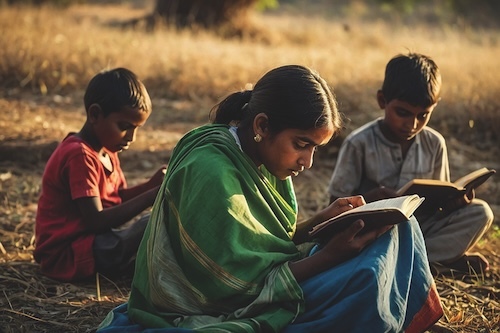
Disciple makers in disciple making movements follow Jesus’ command to sow seed without restraint (Matthew 13). To meet new people and continue sowing abundantly in India, young disciple makers have found creative strategies that fit naturally into daily life. Several themes have emerged:
• College students from diverse caste backgrounds and degree programs are starting Bible studies and house churches on their campuses. They boldly share the message of Jesus with their classmates, living out their faith by sharing as they go. By boldly talking about Jesus with their classmates, they ar creating disciples among their peers.
• Day laborers, both illiterate and semi-literate, are starting Bible studies among working youth. These groups are springing up in fields, chai stalls, and even while shepherding goats. Disciples share stories about Jesus in the midst of their daily routines, proving that anyone, regardless of their education, can join in the Great Commission.
• Many youths share a common interest in music. Music has always held a central place in Indian culture, often carrying deep spiritual meaning. From temple chants and bhajans (Indian devotional songs) to sufi songs and folk traditions, gatherings around music are both communal and devotional. Among Indian youth, informal jam sessions are a common way to connect—friends come together with drums, guitars, or traditional instruments, creating a shared space that naturally draws others in. These settings are already familiar with religious music, since it is common for Hindu, Muslim, and Sikh youth alike to sing devotional songs as part of cultural life. Recognizing this, musically-inclined youth incorporate the simple authenticity of their own faith into their jam sessions, beginning the music time with a simple prayer with whoever is present, and incorporating songs about Jesus or Psalms into their time. As friends gather and hear new songs, they ask questions: “Why did you pray before we played?” or “Where did you learn this song about God?” These natural questions spark deeper conversations, leading to opportunities for prayer and for sharing stories about Jesus. Many house churches have been birthed through this creative and relational approach.
• Parks and playgrounds have become mission fields as youth gather to play cricket, badminton, or football. Before games, disciples pray for safety and strength. This simple practice intrigues Hindu friends, who soon begin asking for prayer themselves or for the disciples to teach them how to pray so they will also become better athletes. Over time, these conversations lead to deeper spiritual exploration and Scripture study. This simple yet effective strategy has also resulted in new house churches.
An Application for Christians in the West
God is doing a great work in this movement in India, as well as in other movements worldwide. In these movements, disciples follow Jesus’ model of discipleship by sowing seeds in ordinary, everyday spaces—such as classrooms, workplaces, jam sessions, and playgrounds. The fruit is undeniable. Over 1 million house churches have been birthed across 19 states in 13 years! What a powerful reminder to all of us that the task to make disciples of Jesus is not reserved for professional ministers or polished programs. Rather, when ordinary disciples take Jesus at his word, they directly apply it to their lives, allowing him to use them in the places where they live, work, and play. They find that the Holy Spirit is right there, equipping them for the task. God loves to save the lost! And he loves to use the supposedly foolish things of this world to shame the supposedly wise.

Author
THE WALKER FAMILY (Pseudonym)
The “Walker” family began cross-cultural work in 2001. In 2006, they joined Beyond (www.beyond.org) and in 2011 started applying CPM principles. They moved countries in 2016 and have been supporting the movements from a distance.
Subscribe to Mission Frontiers
Please consider supporting Mission Frontiers by donating.
Subscribe to our Digital Newsletter and be notified when each new issue is published!