
Reflecting on the early years that led to the development of the US Center for World Mission (now Frontier Ventures), I think of the seeds—the simple invitations, the vision, the community, and the passion of young people—that God used to spark something far bigger than any of us imagined. I feel so blessed to have been drawn into it at an early age. Its impact continues to shape my life over 50 years later. My hope is that today’s younger generation, in whom God is doing a new thing, will catch the vision behind this project, pick up the mantle, and take it further.
An Invitation
I had no idea of the significance of the day when an Indian graduate student came down the hall of the MIT graduate student dorm, knocked on my door, and invited me to Park Street Church in Boston. I had received a full scholarship to MIT to study aeronautics and astronautics with the dream of becoming an astronaut and going to the moon. That student’s invitation eventually led to a radically new ambition in life. My dream of a mission to the moon became a mission to people. That led me to Gordon Conwell Seminary, then the Institute of International Studies (known today as the Perspectives Course), which led to transferring to the School of World Mission at Fuller Seminary, and joining others in founding the US Center for World Mission. The impact of the Center eventually launched us into mission in India, among the largest blocs of frontier peoples.
Amazingly, a few years ago, that same Indian graduate student called me out of the blue and wanted to know how I was doing. He’s followed me all these years. He said he continues to pray for me to this day. What began as a simple invitation to a church launched us, ironically, into the very country he came from. But what were the germinating seeds that led to this new life mission?
Seeds of Calling
During my undergraduate years, I was so inspired by the challenge of difficult pursuits and especially the challenge of going to the moon. I majored in mathematics and aeronautical engineering in pursuit of that dream. During the final months of undergraduate studies, a campus ministry leader invited me to study the Bible and pray with him each morning until graduation. He gave me the Good News for Modern Man translation of the Bible, and the scripture came alive for me. I began to experience a whole new motivation growing inside me. He has no idea to this day the impact his invitation had on my life. His last prayer for me before I left for graduate school at MIT was, “Lord, help him find a good church.” My Indian friend was God’s answer to that prayer.
A Time of Revival
The early years of the 1970s were a time of spiritual revival and renewal in discipleship and evangelism across the United States. Park Street Church’s undergrad and graduate student ministries thrived during those years. The discipleship and expository preaching I received each week at church profoundly marked my life. What I was learning stirred a compelling desire to share my faith. I sought out fellow students to talk about it, and during lunch breaks at Draper Laboratory—where I served as a research assistant—I regularly shared with coworkers what God was doing in my life through Park Street Church.
Every year, the church held a 10-day missions conference. From morning to night, missionaries and mission leaders shared stories of God’s work among the nations. I was deeply moved by what I heard and found myself attending meeting after meeting. The conference concluded with faith-promise pledges, calling the congregation to support the church’s mission program and to consider their own role in God’s global purposes. At the final session, Dr. Paul Toms, our senior pastor, asked, “If you are willing to go anywhere, at any time, for the sake of the gospel, would you stand?” In 1973, compelled by the impact the gospel was having on me, I stood up. From that time on, my focus on going to the moon shifted to people. I was convinced this would have far greater eternal significance. Dr. Toms and Park Street encouraged us (my wife and me) to become missionaries sent by Park Street Church.
Training, Vision, and the Spark of Something Significant
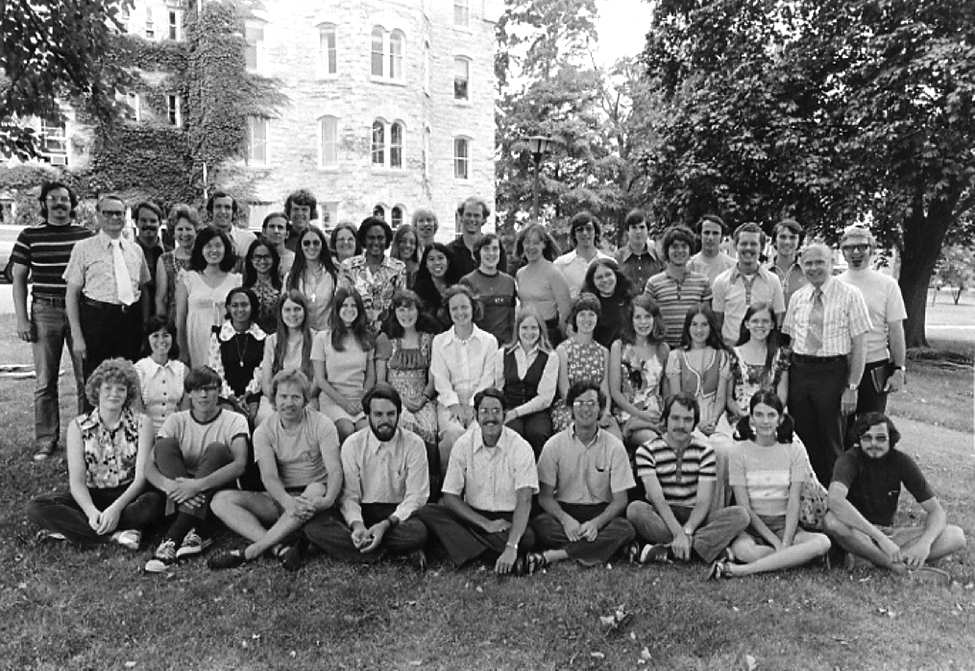
First IIS class—1974, Wheaton College Campus
I decided to take a year’s study at Gordon Conwell Seminary following graduation. I wanted to know the Bible more thoroughly. That year, Dr. Ralph Winter was a guest professor, teaching a one-month course on the World Christian Movement. I joined his class and was deeply impressed by his perspective on mission. He wrote a note on one of my papers inviting me to a program, the Summer Institute of International Studies, that he was creating (1974) on the Wheaton College campus. It was in response to the significant increase in students’ commitments at the Urbana Mission Convention in December 1973.
We were planning for a short-term mission trip to Africa that summer, but Dr. Winter called me several times encouraging us to attend the Institute of International Studies and finally persuaded us. We decided to attend, and Park Street Church supported us financially.
When we arrived at the Wheaton college campus, things seemed a bit unorganized. Dr. Winter was encouraging us to recruit students even after classes began. We became mobilizers! He brought in leading mission professors and experienced missionaries for one-week sessions on the biblical, historical, cultural, and strategic dimensions of world mission. We had classes each morning, studied in the afternoons, and enjoyed informal conversations with the guest teachers in the evenings. Those two months greatly impacted our lives and confirmed God’s call on us.
During that time, Dr. Winter was preparing to give a presentation at the Lausanne Congress on World Evangelization in 1974. As a fellow engineer, he asked me to help with some of the graphics he wanted to use for his presentation. The data and implications behind these graphics were the seed that birthed the US Center for World Mission. They highlighted at that time that 87% of the non-Christian world was beyond the reach of existing Christians. For them to be reached, people would need to cross barriers of culture and language to reach them. Those facts captured my heart.
Students on Fire
We returned to Park Street Church that fall motivated to share what we had learned and to call others into this vision. We formed a mission-focused small group and taught much of what we had learned over the next year in the church. Dr. Winter was planning for the Institute to be held again the following summer. We recruited 22 other students from Park Street to attend with us. Students from the first year were encouraged to return for a second module that would be added to the course. That summer of 1975 birthed another step toward the beginnings of the US Center for World Mission.
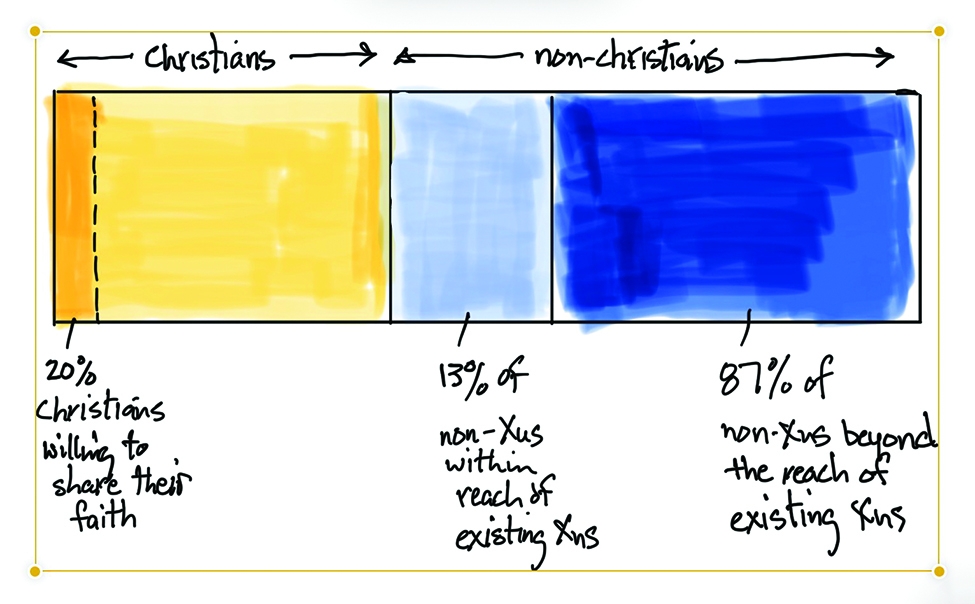
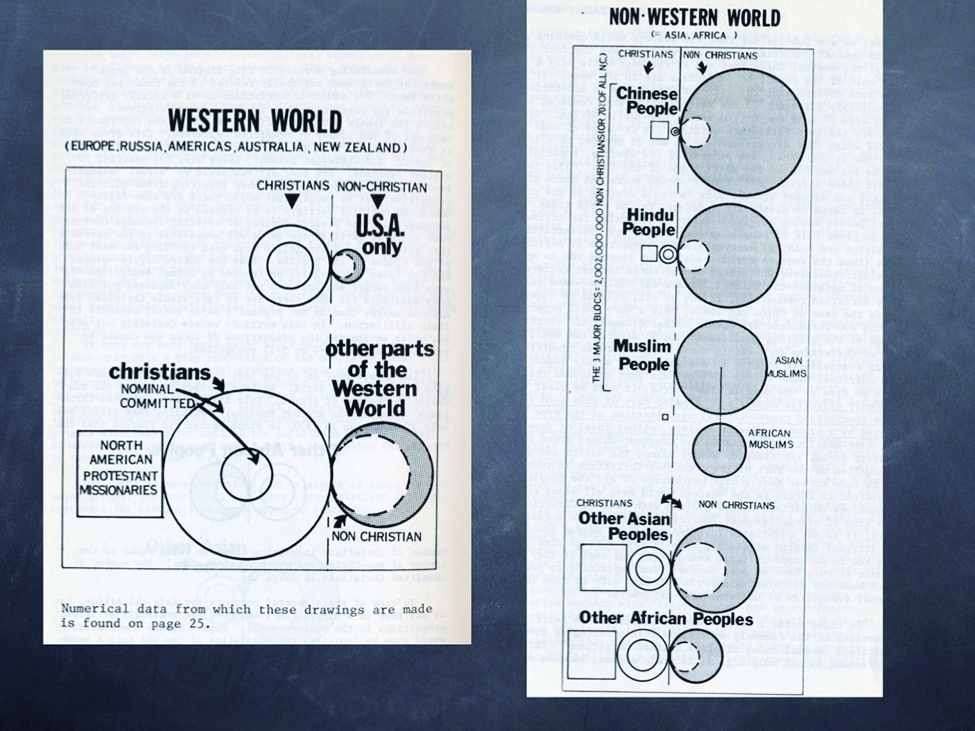
The rectangle that became a pie chart
A Wild Trip, a Committed Community, and a Growing Dream
Charlie Mellis, a student of Dr. Winter, was director of the program that year. He had recently written a book entitled Committed Communities: Fresh Streams for World Mission. It highlighted the significance of mission orders—sodality structures that enable and sustain mission endeavors beyond local fellowships. We learned how young people in previous generations played a significant role in the development of those structures. The student volunteer movement of the late 1800s greatly stimulated our hearts.
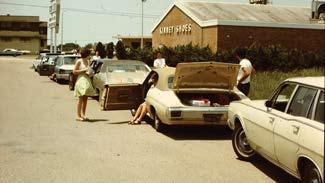
Our caravan to Guatemala
During that summer of 1975, Dr. Winter was on sabbatical from his teaching position at the Fuller School of World Mission. Seeing the enthusiasm of the students the previous year, as well this summer, he organized a cross-cultural mission experience—a trip to Guatemala to visit the places where his family had lived and worked as missionaries. This was a somewhat spur-of-the-moment plan that Dr. Winter came up with. Since we didn’t have enough cars for those wanting to go, we went out and bought old used cars to make the trip. We were a caravan of seven clunkers. We drove non-stop from Wheaton, Illinois to Guatemala, eating sandwiches and switching drivers so we didn’t have to stop to sleep. Diarrhea hit us in Mexico. We almost got lost (and lost each other—no cell phones!) in turnarounds in Mexico City. We talked a lot about committed communities, about forming a community to pursue the vision capturing Dr. Winter’s life. The community would focus on the peoples/ nations that were beyond ordinary evangelistic outreach—the 87%. It was a germinating seed reaching a point of sprouting.
A Campus, a Crisis, and God’s Timing
In the fall of 1975, the School of World Mission began admitting students without field experience—a decision I believe mirrored what God was awakening among young people across the nation in the early 1970s. With the encouragement of Dr. Winter, Dr. Chuck Kraft, and others, I decided to transfer my credits from Gordon Conwell Seminary and attend the School of World Mission. It would give us opportunity to continue working with Dr. Winter in mobilizing young adults to mission and to rub shoulders with more field-experienced missionaries.
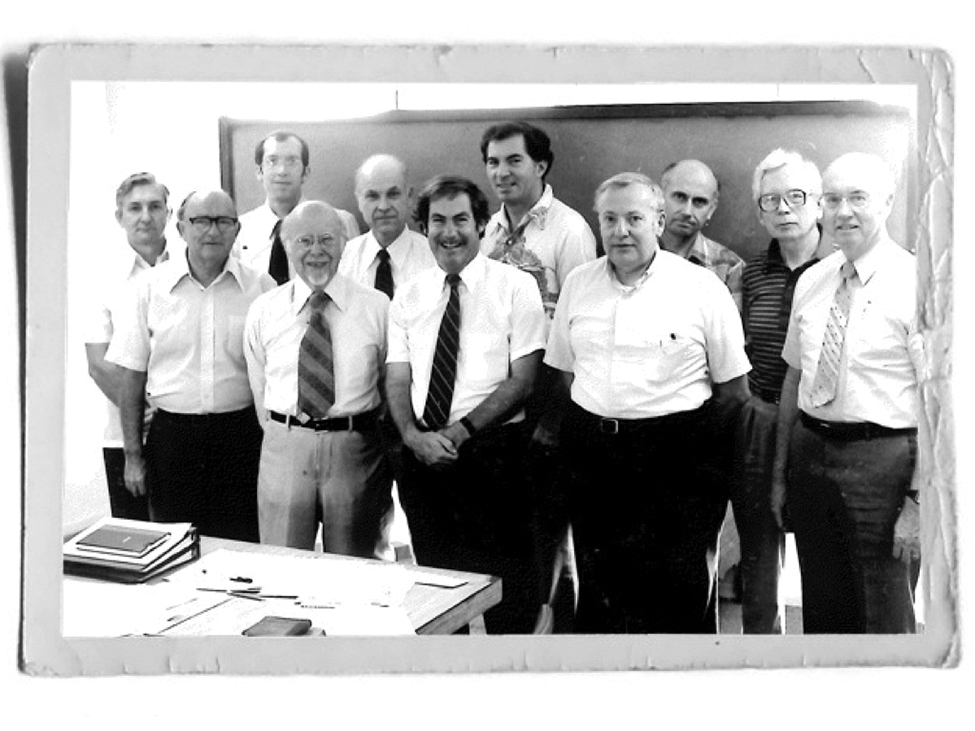
The founding board of USCWM
By now, Dr. Winter was seriously thinking of leaving his position at Fuller to pursue this vision fulltime. This would require a committed community and a place. A campus formerly owned by Pasadena Nazarene College was coming up for sale. Providentially, a Swedish student, Erik Stadell, studying at the School of World Mission at the time, was living near the campus. He learned that the campus was going to be rented to a New Age cult known as Summit Lighthouse, which greatly burdened him. He felt compelled to fast and pray in a little prayer chapel in the middle of the campus until he heard from the Lord regarding the campus. After a week of fasting and prayer, he heard from the Lord. It was to be a Center for World Mission. I can still hear him saying this in his Swedish accent! He didn’t know yet of Dr. Winter’s dreams for a campus.
At that time Dr. Winter decided to leave his position in the School of World Mission and pursue purchasing the campus. He began forming a board of directors. It seemed an impossible pursuit, but the vision was worth the risk.
The Nazarenes, who owned the campus, were facing a predicament. Both Summit Lighthouse and Dr. Winter wanted to buy the campus. Dr. Winter had almost no money, Summit Lighthouse had plenty of money, and the Nazarenes needed money. They didn’t want to sell to a New Age cult, but legal constraints required them to be unbiased. Eventually, the Nazarenes agreed to rent to Summit Lighthouse. They were given a major portion of the campus, all but Hudson Taylor Hall, across the street from the main campus. What an impossible situation God was orchestrating in which he would birth a new thing!
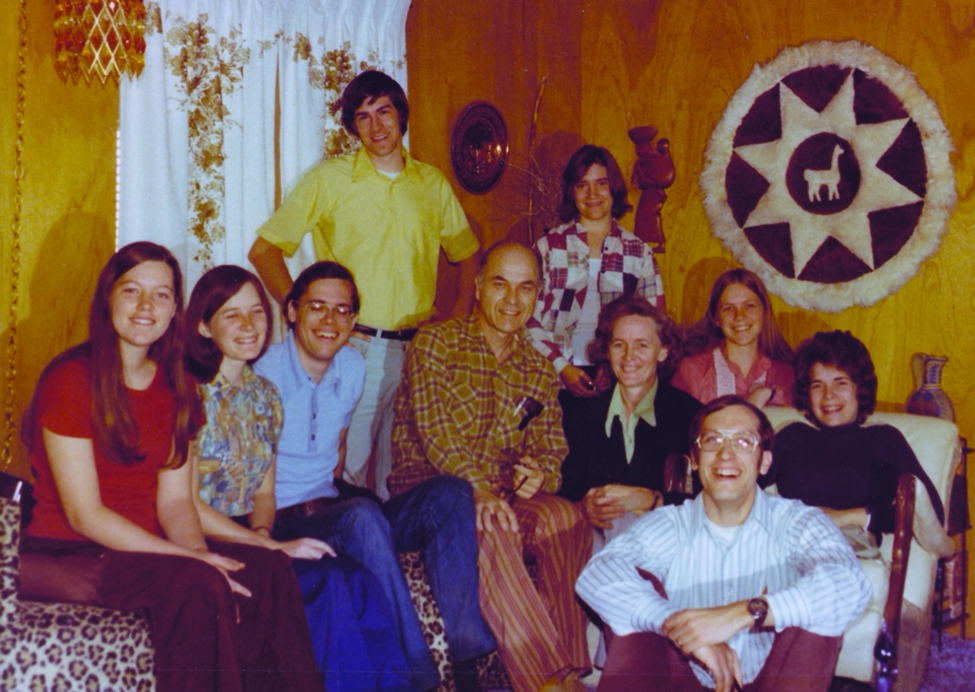
The Winter family and early team
The Drama Unfolds—Prayer, Community, and Big Faith
Dr. Winter asked if there might be some place on the campus where he could set up an office. The Nazarenes offered him a room in Hudson Taylor Hall, across the street from the main campus being rented by Summit Lighthouse. We eventually called this room the “morning meeting room.” A few of us joined him in setting up offices there. We set up a few desks of projects Dr. Winter had already started during his years at Fuller. We set up an IIS desk, Fellowship of World Christians desk, and a Fellowship of Artists and Cultural Evangelists desk. Several of us were alumni of the Institute of International Studies.
We had no computers, no big budget, and no prestige—just typewriters, phones, and a deep sense of family and purpose. Every day we met in the morning meeting room to pray, study Scripture, and celebrate the things God was doing in the world.
We eventually began what we called Jericho Marches around the campus for seven weeks. We prayed. We fasted. We consecrated the campus as a Center for World Mission. We sought every possible means to share the vision of what the campus could become for the sake of the 87% non-Christian world. And slowly, miraculously, God began providing what was needed. Eventually, the entire campus became ours to buy. We were given access to all floors in Hudson Taylor Hall. The Nazarene board gave us option to buy, and eventually down payment was made for the whole campus. The dream began to be fulfilled.
William Carey International University was born once we had access to the whole campus.
The Institute of International Studies launched on campus in January of 1978. Dozens of projects were eventually started.
Frontier missions caught fire across the country within churches and agencies with a new focus on these unreached people groups, originally called hidden peoples, now called frontier peoples. The story continues to this day.
Looking Back
God was at work in the early 1970s.
Dr. Winter valued what God was doing among young people. He invited us into his dream. He built structures to help us grow and invite others into. He gave us responsibility. He discipled us in the work. We were a committed community, daily walking in the Word, prayer, and life together as we pursued the dream.
Faith led us—not money, not what was possible. We embraced the vision in faith. As we worked to make our mission known—simply to keep the campus going—we discovered something deeper. Our true mission was to shine a light on the unreached peoples of the world. The facts and statistics weren’t just information; they were a wake-up call. They stirred our hearts, moved us to action, and ignited the same passion in countless others.
Passing the Baton to the Next Generation
And now, five decades later, I’m seeing something familiar—a new stirring among young people across the nation. A new hunger for purpose. A desire for community. A longing for significance that goes beyond career or comfort.
A new day has dawned in pursuit of a long-held dream: To see the gospel firmly planted among every people group and nation where no local fellowship yet exists of that people. Much has been accomplished. Since the 1970s, countless peoples and nations have been reached—but the work is not finished. This remains the heartbeat of Frontier Ventures. To the young people of this generation, as happened to me, I invite you to come, join us, and become part of a story God is still working to fulfill.
Author
Bruce Graham
Bruce Graham was part of the founding team of the USCWM/Frontier Ventures. He served on staff in Pasadena for 20 years and in India for 12 years.
Subscribe to Mission Frontiers
Please consider supporting Mission Frontiers by donating.
Subscribe to our Digital Newsletter and be notified when each new issue is published!