
The apostle John saw something breathtaking in a vision, which he described in Revelation 5:9, “You are worthy to take the scroll and to open its seals, for you were slaughtered and by your blood you ransomed for God saints from every tribe and language and people and nation.” This scene is striking. It’s not about uniformity but diversity. This is not a mass of people who look the same, talk the same, and worship the same. Rather, it is a gloriously varied chorus with distinct voices contributing something irreplaceable to the song.
This vision drives and empowers the work of frontier missions; it’s why it exists! And yet, it also raises a question that those of us working in this space must take seriously: If the Kingdom of God is meant to include every tribe and tongue in their diversity, does our technology actually reflect that?
The Paradox of Modern Missions
Take a moment to consider the technology that shapes much of your frontier mission work. The platforms we use to work, to train, and to distribute resources were more often than not built in Western spaces with Western assumptions. They typically assume reliable high-speed internet access, a deep literacy in a globally dominant language, and organizational structures modeled on Western ideals. They are often powerful tools with good purposes, but they carry embedded assumptions about how people learn, how communities make decisions, and how knowledge should be organized. These assumptions don’t always map neatly onto the diverse contexts where the gospel is still taking root.
Put simply, we pursue a vision of dazzling diversity with tools designed to treat and make us the same. We dream of Revelation 5 while building with the logic of Babel. This is not a matter of bad intentions. It is a matter of unexamined defaults. And if we want our technology to truly serve the kingdom vision, those defaults must be examined.
Babel and Pentecost: Two Models of Technology
Scripture gives us two interesting paradigms for thinking about technology, innovation, and culture. The first is Babel. In Genesis 11, all of humanity gathers around a shared technological project and in doing so, collapses all diversity into a single language, a single agenda, a single center of power. That project was a tower designed to reach into the heavens all the way to God. Babel speaks implicitly to the impulse to standardize and erase difference in the name of efficiency and control. Babel tends to be the default position for technology.
The second paradigm is Pentecost. In Acts 2, the Spirit descends and the result is not one language imposed on all, but every language spoken simultaneously. The miracle of Pentecost is that the gospel goes out in the native tongues of all of the listeners, whoever they are! They each get to hear the good news in their own voice. Pentecost does not eliminate diversity; it amplifies it and dignifies it.
Technology can serve either paradigm. Platforms that require every community to adopt the same interface, the same language, the same workflow build towards Babel. Platforms that are designed to meet people in their own context and distribute power rather than concentrate it, build towards Pentecost.
The Harmony Way
Keetoowah Cherokee scholar Randy Woodley offers a framework that enriches this theological vision. What the Hebrew Scriptures call shalom (peace, wholeness, flourishing), Woodley describes through the indigenous concept of the “Harmony Way.”1 Where Western thinking tends to define progress as a linear march forward, the Harmony Way understands flourishing as interconnectedness—right relationship between people, between communities, and between humanity and creation.
This distinction matters profoundly for how we think about missions and technology. The Western progress narrative assumes that newer is better, that scale equals success, and that efficiency is the highest virtue. The Harmony Way asks different questions: Does this tool strengthen relationships within a community? Does it allow the kingdom to flourish within a culture on its own terms, in its own voice, through its own leaders? Or does it quietly replace local ways of knowing with imported ones?
Platforms should be flexible. They should distribute rather than concentrate power. They should intentionally create space for the Harmony Way. When it is rigid and centralized, we don’t achieve the Harmony Way, no matter how good our intentions.
Small Is Beautiful: Schumacher and Appropriate Technology
The practical framework for this kind of thinking already exists. In his landmark 1973 work Small Is Beautiful,2 economist E.F. Schumacher introduced the concept of “appropriate technology.”3 Drawing on the influence of Mahatma Gandhi, Schumacher argued that the best technology for any context is not necessarily the most advanced but rather the most fitting. He identified three core principles:
1. Accessibility: Appropriate technology must be cheap enough to be available to virtually everyone, not just those with institutional budgets or Western donors. If the person at the furthest edge of a network cannot afford or access the tool, it is not appropriate for the work of reaching “every tribe.”
2. Scale: Schumacher argued that small-scale application is more human than industrial-scale deployment. Small operations respect both human dignity and local context in ways that massive, centralized systems cannot. In a missions context, this means empowering local leaders to build, adapt, and own solutions rather than handing them platforms designed for mega-organizations.
3. Compatibility with human creativity: The right tool enhances what people can do; it does not replace them. Gandhi framed this as “production by the masses” versus “mass production.”4 In missions, this translates to a clear principle: Technology should make local leaders more capable, not more dependent on Western expertise.
The Shadow of Inappropriate Technology
When we fail to apply these principles, the consequences are real. High-cost and high-maintenance technology—like software that requires expensive licenses, hardware that needs specialized repair, or systems that need constant connectivity—quietly centralizes power in the hands of those who can afford it. The tech-literate become gatekeepers, and local leaders become consumers rather than creators.
There is also the subtler problem of cultural erasure. When the platforms we use don’t support local scripts, can’t accommodate oral traditions, or impose individualistic decision-making structures on communal cultures, something is lost. The content may be translated, but the way knowledge is shared, discussed, and lived remains foreign. The gospel arrives, but it arrives in someone else’s packaging.
An indigenous leader once lamented to me about how their team and colleagues weren’t trusted to make and maintain their own training material. Instead, they were expected to use material created elsewhere, full of examples and metaphors and visuals that made little sense in their culture. And they were expected to access it all using a file tool that no one used and few had access to, which left them either dependent on outsiders or scrambling to make things work. What they asked me for left a deep impression—space. They desired a place of their own to collect and access and share and celebrate who they were as a movement and a people. That conversation has stayed with me. It captures what’s at stake when we get this wrong. The issue isn’t just inefficiency, it’s dignity.
Imagining Kingdom Innovation
So what does appropriate technology look like in practice? At Ethnē, we are learning that the answer lies primarily in holding two commitments: flexible platforms and distributed power.
Consider the challenge of Scripture access. Data from internetpoverty.io reveals a staggering reality: In many regions, downloading an audio Bible can cost 10 percent of a person’s monthly income. Offline-first applications (tools that work without constant connectivity and allow audio Bible sharing through locally created, on-device networks) can address this directly. They don’t require the infrastructure of the Global North. They meet people where they are.
Or consider the rise of no-code tools that allow local leaders to build their own solutions. Rather than waiting for a Western development team to design an app that may or may not fit their context, leaders on the ground can create platforms that prioritize their own content, adapt to the forms and structures that make sense in their culture, and integrate the resources they actually need: Scripture in local languages, security protocols appropriate to their setting, and communication tools shaped by their community’s patterns. The platform becomes a servant rather than a master.
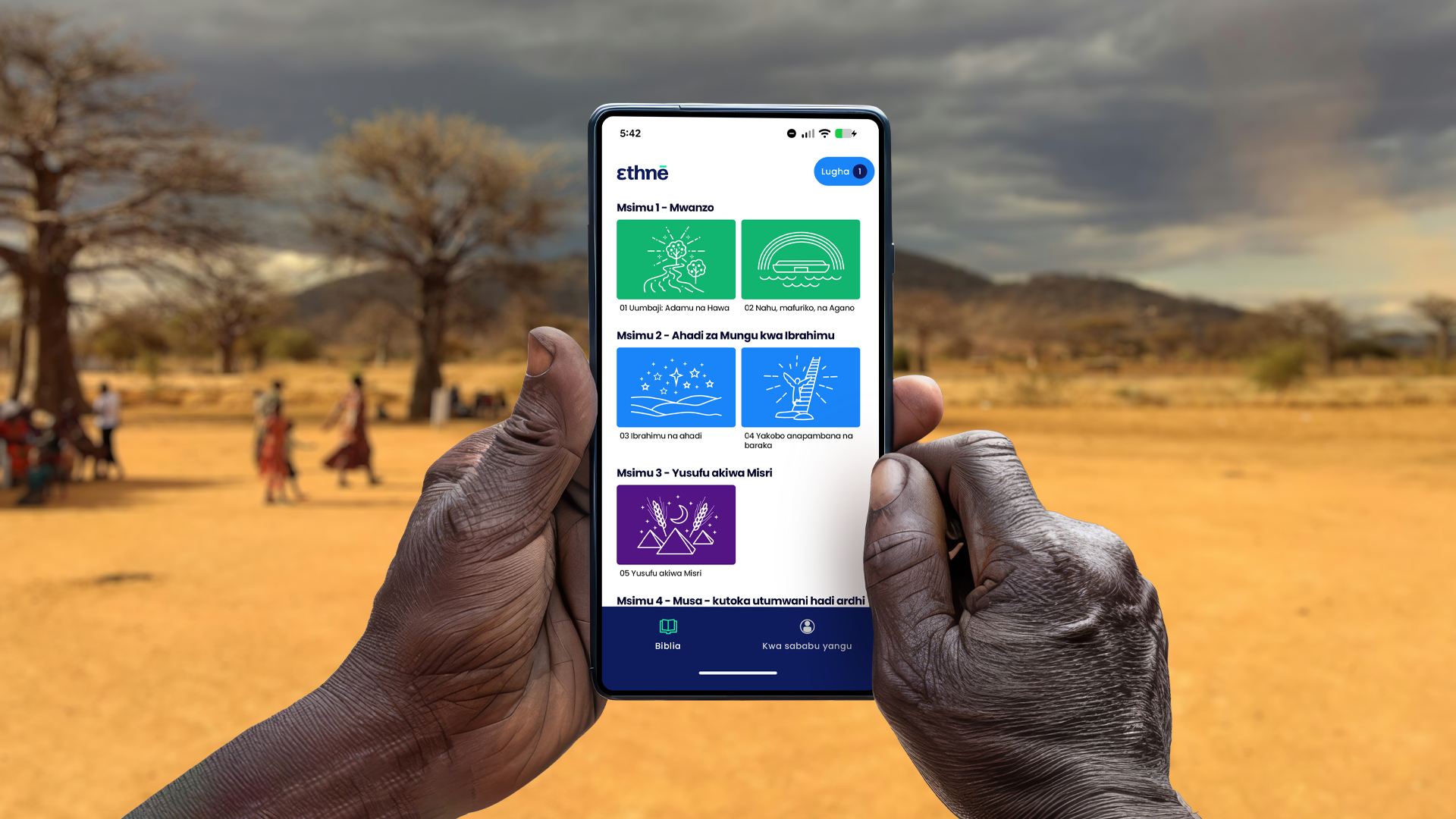
At Ethnē, one significant way we are working toward this is through what we call “Channels.”5 Channels is our effort to democratize the process. Cost is based on ministry budgets rather than typical industry metrics, because accessibility has to start with pricing. Local leaders need little other than their own material and resources—whether WhatsApp audio, Word documents, or hand-drawn illustrations. We work with people to build custom, accessible channels of their content for their people in the languages they want and need. Channels adapt to the form and structure of that content to create a small-scale app within an app, with the added benefit of integrated Bibles, professional security management, and more. The point is that the platform serves the content and the community, not the other way around.
We should be honest, though: At Ethnē, we aren’t immune to these struggles ourselves. Technology and innovation carry a cost and the tension between what’s ideal and what’s sustainable is real. Channels has been built specifically with this tension in mind. It’s designed to lower the barriers that make appropriate technology so hard to sustain over time. But the work is ongoing, and we are learning as we go.
And notably, this is not a call to abandon sophisticated technology. It is a call to reorient it. The role of the innovator in missions is not to arrive as the “bringer of solutions,” parachuting in with a finished product. It is to serve as a co-creator. We should all be people who listen carefully to both the king and the culture simultaneously, building tools in genuine partnership with local communities. The best missionary technologists are not those who export their expertise but those who multiply the capacity of others. The posture matters as much as the product.
Through the Eyes of the King
The history of missions is marked by moments of profound faithfulness and moments of painful blindness. Some of our greatest missteps have come not from malice but from failing to question the tools we carried. The modernization narrative told us that progress meant adoption, whether adoption of Western languages, Western institutions, or Western technology. We are still reckoning with the cost of that assumption.
But reckoning with the past is not enough. We must also imagine the future, and we must imagine it through the eyes of the king whose vision we serve. That vision is gloriously diverse. It does not flatten. It does not homogenize. It gathers every tribe and tongue and people and nation and it seats them all at the same table.
Technology is never neutral. Every tool carries assumptions about who matters, how knowledge works, and where power belongs. A platform that centralizes control, builds a tower. A platform that distributes power, respects local creativity, and meets people in their own language and their own context sets a table.
The question before us is not whether we will use technology in frontier missions, because of course we will. The question is whether we will use it thoughtfully enough to serve the kingdom as it actually is: breathtakingly diverse, rooted in the Harmony Way, flourishing in every culture on its own terms. Let us build tools that set the table for every tribe.
1 Randy S. Woodley, “The Harmony Way: Integrating Indigenous Values Within Native North American Theology and Mission” (PhD diss., Asbury Theological Seminary, 2010), 20. digitalcommons.georgefox.edu/gfes/72.
2 Schumacher, E.F. Small Is Beautiful: Economics as if People Mattered (New York: Harper & Row, 1973), chaps. 2, 10, 12.
3 Ibid, 130.
4 Ibid, 112.
5 See ethne.tech/channels
Author
BRANDON
All Scripture references from the NRSV.
Brandon has spent more than 15 years involved in frontier mission work. He’s worn a lot of different hats but is most passionate about helping people think strategically. He currently works with Ethnē. ethne.tech
Subscribe to Mission Frontiers
Please consider supporting Mission Frontiers by donating.
Subscribe to our Digital Newsletter and be notified when each new issue is published!