
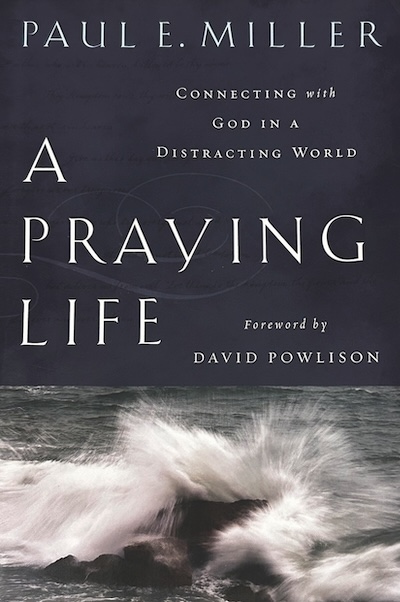
Paul E. Miller’s A Praying Life: Connecting with God in a Distracting World was born in the crucible of suffering. Don’t read this one for peppy pick-me-ups or hollow platitudes. Miller has lived a life of prayer and writes from the place of someone who has walked the walk.
We read this book in our book club about five years ago, and it had such an impact on me, it was the first book that came to mind when I considered something to review for this prayer issue of MF. Going back through it reminded me why.
Miller’s personal stories, humility, and vulnerability give the book color and depth. He wrestles with painful questions all of us have asked and answers them from a place of deep faith. He opens the book writing, “I never started out to write a book on prayer. I simply discovered that I’d learned how to pray. Life’s unexpected turns had created a path in my heart to God; God taught me to pray through suffering.”1
He divides A Praying Life into five parts, walking the reader through learning to pray like a child, learning to trust, learning to ask your Father, what it means to recognize we are in God’s story, and then ending with practical tips on prayer. As mentioned, he sprinkles personal stories throughout, inviting us into his journey.
Early on, Miller gives us a picture of what he is describing. He writes, “The praying life...feels like dinner with good friends.”2 But he avoids romanticizing prayer or giving an overly spiritualized picture of prayer making life easy. He tells us, “Learning to pray doesn’t offer us a less busy life; it offers us a less busy heart.”3
Miller has a severely autistic daughter, Kim, who is mute, and many of his stories revolve around the impact she has had on him and his family. Besides Kim, his youngest daughter, Emily, gets the most anecdotes as he shares about the decade-long journey of praying for God to form her heart. He uses these stories not to show what a great parent he was, but rather to show how helpless and inept he was apart from prayer. He learned early on that God wanted him just as he was. He writes, “The difficulty of coming just as we are is that we are messy. And prayer makes it worse. When we slow down to pray, we are immediately confronted with how unspiritual we are, with how difficult it is to concentrate on God.”4
In part one, he calls us to be like children who are helpless. He makes the point that we only pray about things we can’t do ourselves. Our prayer life reveals how helpless we feel. He learned this lesson first and foremost through parenting. “It didn’t take me long to realize that I did my best parenting by prayer. I began to speak less to the kids and more to God. It was actually quite relaxing.”5
Personally, I was convicted throughout the book, but when he shared about his role as a leader, I saw myself in the mirror and didn’t like the reflection. He writes, “I’m at my worst when I’m passionate about a new idea. I can drift into selling instead of listening and can easily become dominating.”6 Perhaps you also come from a culture that idolizes leaders with big vision and big ideas who are charismatic and command the room. Miller calls us to a childlike sense of helplessness, trusting Jesus to lead. Of course, this doesn’t mean we never state an opinion or call people to more, but often I’m convicted that I lead out of a place of anxiety rather than faith. My capacity and openness to listening is a good barometer for me, and Miller nails it.
In the second part, Miller addresses cynicism’s insidious work in keeping us from developing a life of prayer. He writes, “When I say that cynicism is the spirit of the age, I mean it is an influence, a tone that permeates our culture, one of the master temptations of our age.”7 He continues, “[Cynicism] protects you from crushing disappointment, but it paralyzes you from doing anything... It is without hope.”8 The antidote to cynicism is connecting with God’s heart. “Hope begins with the heart of God. As you grasp what the Father’s heart is like, how he loves to give, then prayer will begin to feel completely natural to you.”9 The reason for this is that “God is not cynical in the face of evil. He loves.”10
Having dealt with cynicism, Miller turns in part three to our vulnerability and lack of control, which is both exhilarating and terrifying. It means we must ask; most of us don’t enjoy asking for things, and as Christians, many of us have given up believing God really will give. Miller tells us, “Learned desperation is at the heart of a praying life.”11 He follows with this zinger, “All of Jesus’ teaching on prayer in the Gospels can be summarized with one word: ask.”12
This leads him into a discussion about desire and surrender. We acknowledge our desires and, at the same time, surrender to God who is in control. “If you are sinking on the Titanic, you pray, God, get me a place on a lifeboat, and then you put all your energy into helping other people get on. Desire and surrender are the perfect balance to praying.”13
In part four, we explore what it means to be part of God’s story. We have already acknowledged that we are not in control. We are surrendering to a good God who is authoring something beautiful and inviting us to participate. As with all great stories, suspense and conflict and darkness and love are woven throughout. We will experience times in the desert, and they will grow us. “When you persist in a spiritual vacuum, when you hang in there during ambiguity, you get to know God.”14 And yet, because God is good, we are reminded to hope: “When the story isn’t going your way, ask yourself, ‘What is God doing?’ Be on the lookout for strange gifts.”15
Having taken us on the journey, Miller concludes in part five with practical tips, sharing what he has found most helpful for sustaining him in his life of prayer. He gives helpful details on how to develop a deck of prayer cards, a tool he refers to throughout the book, and, then, he describes his method of prayer journaling. Since reading the book, I have found both these tools helpful.
In conclusion, I will note that although I have shared the thread running through the book, you really need to read it to catch what he is saying. I’ll close with a question Miller asks towards the end of the book. Hopefully, it will give you something to ponder as you order this excellent book.
“I woke up in the middle of the night recently with this rather odd question on my mind: How would you love someone without prayer?”16
1 Miller, Paul E. A Praying Life: Connecting with God in a Distracting World (Colorado Springs: NavPress, 2009), 11.
2 Ibid, 19.
3 Ibid, 23.
4 Ibid, 31.
5 Miller, 60.
6 Ibid, 64.
7 Ibid, 77.
8 Ibid, 79.
9 Ibid, 85.
10 Ibid, 91.
11 Ibid, 114.
12 Ibid, 134.
13 Ibid, 123.
14 Ibid, 190.
15 Ibid, 203.
16 Ibid, 258.
Author
DUKE DILLARD
Duke Dillard served overseas for 18+ years before settling in Denton, Texas, in 2019 with his wife, Laurie, and their seven children. He helps people and organizations become fully who God created them to be. He loves spending time with his wife, children, and grandchildren.
Subscribe to Mission Frontiers
Please consider supporting Mission Frontiers by donating.
Subscribe to our Digital Newsletter and be notified when each new issue is published!