
David Platt has famously said that the unreached are unreached for a reason, all the easy ones have already been reached with the gospel.1
This tongue-in-cheek quote underscores a harsh reality of the task of world evangelization today, especially as it pertains to the nearly 3 billion people living among the 7,000 unreached people groups scattered throughout the globe. Who will go?
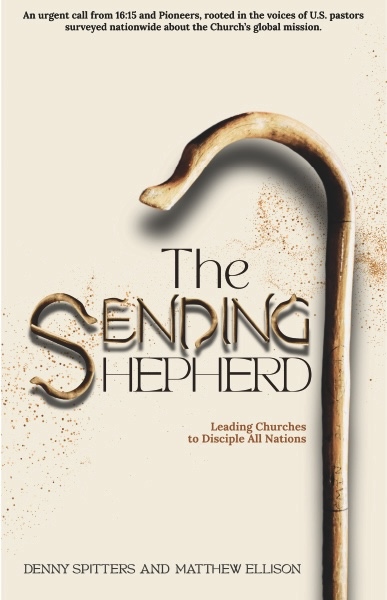
While Denny Spitters and Matthew Ellision’s 2025 book, The Sending Shepherd: Leading Churches to Disciple All Nations does not specifically address the topic of risk per se, it does speak to the problem of missions mobilization in American churches. The authors’ heart is to see the churches in the United States once again take seriously the Great Commission call to send people to the “gospel Sahara zones” where there is no active Christian witness.2 They see this as the rightful response of all faithful churches.
Spitters and Ellison wrote The Sending Shepherd as a joint effort between two respected mission organizations: Pioneers and 16:15. Together they commissioned the Barna Group to conduct new research of American pastors on their attitudes and perspectives towards global missions. This book represents both the findings of that survey as well as their counsel to the church in America on how to proceed. The Sending Shepherd is designed to help church leaders honestly assess where their churches stand in relation to God’s global mission and to provide practical, encouraging steps to mobilize their congregations for meaningful engagement in the Great Commission.
The book itself is short and easy to read (only 133 pages with generous spacing and margins). The authors’ intent seems to be to make the material readily accessible and digestible to busy pastors. As such, it is not an academic work and is lacking in footnotes and cross-references, as well as any framework for deeper missiological dialogue. Spitters and Ellison do open their book with a glossary of their key terms such as missions versus mission versus missional.
The Survey Says…
In the first section of the book, the authors lay out the major findings of the Barna research, grouping the results as five main challenges and five key strengths. The five challenges that emerged from listening to American pastors speak about the state of mobilization are: 1) missions is rarely preached in churches today, 2) the definition of missions is confused and diluted, 3) churches prioritize local outreach over cross-cultural missions, 4) pastors do not feel equipped to talk about missions, and 5) missions success is measured broadly but not strategically. Spitters and Ellison expound on each of these statements in this section.
Next, they identify five key strengths present in the American church that could help foster future missions mobilization efforts. These include: 1) pastors have a strong passion for the Great Commission, 2) missions is regarded as a core biblical mandate, 3) outreach and compassion ministries are esteemed, 4) financial support for missions still exists, and finally 5) pastors hold decision-making ability to influence change. In each of these strengths, the authors cite numerous helpful statistics from the survey.
The most fascinating conclusion that emerges from the data is the gap that exists between pastors realizing that the Great Commission is a central mandate for all believers and yet the lack of action steps toward accomplishing it. For example, 98% of pastors agree that the Great Commission is a mandate for all Christians,3 yet only 22% teach on missions!4
What Next?
The Sending Shepherd is Spitters and Ellison’s attempt to close that gap through concrete steps, motivational teaching, and inspirational testimonies. In section two, the authors present their response to the problem facing American pastors. The authors believe the core problem facing the church is one of mobilization. In the closest they come to a thesis statement, Spitters and Ellison argue, “[W]e are suggesting that to be a healthy disciple of Jesus Christ, we cannot marginalize what is central to Him. Missions is vital not only for reaching the world, but also for the health and obedience of the Church.”5 Integrating the Great Commission into the local church is essential for a healthy church. They use Acts 13 and the church at Antioch as a model for how a church can integrate missions into their local congregational life.
In section three, the authors write their final pleas that are the most direct and missiological. In chapter 9, Spitters addresses why it is still important for the American church to be sending cross-cultural missionaries to the unreached. In chapter 10, Ellison turns to Revelation 7:9-10 and gives not only a picture of the future heavenly worship around the throne but a prophetic warning and invitation. “In the end, we will have no justification for our neglect of mission. What we have dismissed as secondary will be revealed as a central concern of God’s redemptive plan.”6
The last section includes several testimonials of pastors and churches who have seen fruit in both their local churches and global outreach. Almost all these stories are from those who went through the coaching and consulting program of 16:15. While encouraging, it was also slightly off-putting as it felt like an advertisement for 16:15’s product.
Final Analysis
Overall, I applaud Spitters and Ellison for their tireless work in mobilization and helping American churches fully lean into their Great Commission calling and identity. The Sending Shepherd is a much needed and easily accessible book to encourage pastors who are either interested in missions but don’t know what to do next or who are new to the idea of missions and wondering why it matters. The research itself is well done and very helpful in giving a realistic picture of where the American church is pertaining to missions mobilization. This alone makes it a worthy resource.
However, in its attempt to be accessible, the book at times comes across as too simplistic or formulaic. The action steps the authors give do not seem to truly answer the deeper underlying question of why the American church is becoming increasingly risk-averse and alarmingly isolationist. It may lie beyond the scope of The Sending Shepherd, but more work is needed on understanding why the gap exists in the first place.
In addition, while the audience is very clearly North American pastors and the authors are trying to keep the book short, the result unfortunately lacks depth. For example, when the topic of risk arose in the book, it was primarily defined as “getting out of one’s comfort zone” and accepting that getting involved in missions work will be inconvenient and difficult. There was only a passing reference to persecution.7 If Platt is correct, taking the gospel to the unreached will involve a lot more than merely getting out of our comfort zones. This book would have benefited from more depth on these issues without losing its accessibility.
In conclusion, to accomplish the Great Commission, American churches will need to continue to mobilize and send to the “gospel Sahara zones” of the world. While that may seem less likely on the surface, Spitters and Ellison remind us to not give up hope for what is still the largest sending nation in the world.
1 Platt, David. Don’t Hold Back: Leaving Comfortable Plans for the Radical Will of God (Multnomah, 2023), 114.
2 Spitters, Denny, and Matthew Ellison. The Sending Shepherd: Leading Churches to Disciple All Nations (Sixteen:Fifteen, 2025), 4.
3 Spitters and Ellison, 21.
4 Spitters and Ellison, 13.
5 Spitters and Ellison, 39.
6 Spitters and Ellison, 93.
7 Spitters and Ellison, 47.
Author
Denny Spitters & Matthew Ellison Review by ERIK MEBERG
Erik Meberg is regional team co-leader for Barnabas International providing pastoral care and leadership development for global workers and national leaders serving among the least reached. He is currently working towards his doctorate at Erskine Seminary.
Subscribe to Mission Frontiers
Please consider supporting Mission Frontiers by donating.
Subscribe to our Digital Newsletter and be notified when each new issue is published!