
I was first introduced to India and Hindu people during the first missions conference I attended. I was a
19-year-old college student from a backwater, small town in northeast Ohio and quite unaware of the larger world. I vividly remember sitting spellbound while the missionaries described their experiences living and serving in different countries all over the world. I was fascinated.
One evening, a missionary spoke about India. He said that most people there were Hindu and lived in villages. I didn’t quite know what a Hindu was, and I had never seen a village. Images of village huts, bullock carts, and palm trees filled my mind. Then, the missionary said that there were 700,000 of these villages in India with no local church. My sense of wonder turned into shock. I had no idea that there were vast populations of people in the world with no access to a local church. “How could this be true?” I wondered. My understanding of the world was changing fast, and my young, impressionable soul was deeply moved. To make a long story short, I was sure that God was speaking to me, so I surrendered myself to be a missionary to India. I was going to make sure that a local church was planted in every Indian village so that Hindus could be introduced to God. Remember, I was 19 years old so cut me some slack, okay?
As God is wont to do, he refined and clarified my vision. Over the years, I learned that Jesus really is Lord of all and his Lordship extends to everyone, everywhere. This includes every Hindu village in all South Asia. I also learned that missionary presentations about shocking spiritual need within vast populations of non-Christians, the kind which had so moved me, may be effective for mobilization or fund raising but are not always accurate representations of how those people may or may not be experiencing the Lordship of Christ. I moved away from thinking about the world from a window seat at 30,000 feet and began to live among Hindu people on the ground.
What I found was family. Looking back, I can’t imagine what else I thought I would find, but remember, my thinking had been almost entirely shaped by the so-called “big picture” of missions mobilization, unreached people, who goes to heaven, and who goes to hell. I must confess that I subconsciously believed that Hindu people were fundamentally different than me. Everyone I knew in my own culture, including myself, was intensely loyal to their family and lived a family-centered life, but it somehow never occurred to me that Hindus lived like that as well. I had objectified Hindus, classified them, spiritualized them, (de-spiritualized them, actually) and judged them, even though I knew nothing at all about them. As I began living within Hindu communities and coming alongside Hindu families, I found that Hindu people aren’t different. They live in large extended families and clans and groups of families and clans with comparable culture (caste) that usually have more influence on the life of the individual members of their family than what normally takes place in most Western families. A heart for the gospel to grow among unreached Hindu people is a calling to come alongside Hindu families.
We got to know the entire Khedut family through their two sons who played cricket with their friends in a small, abandoned lot near our house. One day, I walked over to watch them play. They were afraid that they had somehow trespassed, so the oldest boy named Mukund asked me in his broken English if everything was okay. I said it was, and a friendly relationship developed between me and these 10 teenage boys. Eventually, Mukund invited my wife and me to come to his house, so we followed him home after the cricket match. His parents, brother, sister, grandmother, and brother-in-law warmly received us, and we spent a pleasant afternoon with them drinking tea, eating some spicy snacks, and just getting to know one another. Over time, we shared meals with them at their house, invited them to our place for tea (they were afraid to eat what we made; the women wouldn’t touch a thing, always fasting, apparently). We all became friends, a cross-cultural friendship in which we came alongside them, and they came alongside us in daily life.
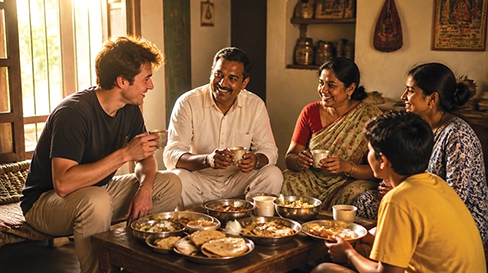
Over the space of about a year, we found that the Khedut family had some problems. They gradually shared their concerns with us because we were safe—outsiders who would not gossip within their network of other Khedut families. We prayed for them in Jesus’ name and tried to be an encouragement. We did not try to formally lead them to Christ. One day, Mr. Khedut told me that he was a sinful man. I said that I already knew that, and he cried with remorse and shame. I simply said, “Jesus will forgive all your sins.” He looked at me and said, “Really?” “Yes,” I said, “he has authority from God to do that.” I led him in a prayer asking for forgiveness from God in Jesus’ name. What followed can only be understood as the power of the Holy Spirit and the eternal truth of the gospel. Mr. Khedut began getting his life in order, his family was happier than they had been in years, and word spread throughout their entire extended family about us and our powerful God, Jesus Christ.
In the following three years, we got to know the entire Khedut family and many of their friends and their families. They blessed us and we sought to bless them whenever we could. We went to family gatherings and events. We put together times for singing hymns about Jesus (bhajans), we read the Bible together, and they took us to pray for their family members. Coming alongside the Khedut family in this way gave us the opportunity to be witnesses for Christ to hundreds of Hindu people. As a result, many people began traveling toward devotion to Jesus.
To be honest, though, their devotion to Christ remained uneven; many continued to struggle with sin, and most regrettable of all, we realized that we did not know how to effectively partner with these forward caste Hindu families in mutual discipleship toward loyalty to Jesus Christ. In many ways we failed, but we trust in the grace of God for all of these people. The Khedut family is thriving today. They love us, but they have never become unambiguously loyal to Jesus Christ, though they “believe” in him. Their ultimate loyalty lies in a Vaishnava religion called Swami Narayan. The gospel movement we hoped to see happen became an exhausting, confusing struggle that didn’t bear lasting, observable fruit.
We met the Desasvami family in the courtyard of their apartment building. We were walking down the street, saw them, said hello, and five minutes later were drinking water in their apartment. This is atithi, an unexpected guest whom we treat like God. Atithi is a warm and exemplary aspect of Hindu culture. This family was Mr. and Mrs. Desasvami and their young children. A lady named Rose from a different family, but the same caste (Brahman) also lived with them. We eventually realized that one of Mukund Khedut’s friends was the son of Mr. Desasvami’s brother, who lived in an apartment a block away. We visited with all of them often and got to know them well. As in the Khedut family, this highly religious Brahman family had problems they would share with us. We would pray for them and try to encourage them, though we never really connected deeply with them as we had with the Khedut family. One day, the sister-in-law of Mr. Desasvami and mother of Mukund’s friend told us that she believed in Jesus. We were joyfully shocked, but her husband became furious upon learning about this, threatened me, and stopped any further contact. Our relationship with the entire Desasvami family ceased.
A few months later, Rose invited us to meet her new husband in their apartment. We were surprised because she was certainly aware of the anger which the Desasvami family had for us, but it became clear that she had been speaking with the Desasvami sister-in-law who had told us that she believed in Jesus. As we sat in their home, she told us and her husband that she, too, believed in Jesus. Then she told her very religious husband that he should, too! These people were Brahmans, the highest Hindu caste, and her husband made it quite clear that this was off the table. We saw them around town from time to time, but no relationship was possible.
These are two examples of coming alongside Hindu families in mutual benefit and being granted a measure of influence for Christ within their social networks. We could offer many others, some much more successful, but I chose to use these two examples because they were the crucible in which we discovered the widely experienced but rarely talked about reality that it is basically impossible for Christians to come alongside forward caste Hindu families and disciple them toward loyalty to Christ. Does that offend you? It’s true. But the fact that it’s impossible doesn’t mean anything. Many people who come alongside Hindu families do so in the realm of the impossible, though they often don’t think they are making very much headway. But doing the impossible is what we are called to do if the Lord leads us to come alongside a Hindu family in the name of Jesus. Once we accept that, we can relax and put aside the internalized pressures that often trouble us about this kind of ministry and focus our energies on the business of doing the impossible.
Author
TIM SHULTZ
Tim Shultz and his wife Melanie have been serving as missionaries since 1987. They have three adult children and three grandchildren. They live in New Jersey.
Subscribe to Mission Frontiers
Please consider supporting Mission Frontiers by donating.
Subscribe to our Digital Newsletter and be notified when each new issue is published!