
This title breathes wonder and incredulity at the same time. How is it that 50 years have passed since the founding of the US Center for World Mission (USCWM)1, and how is it that I now have a first-hand account of some part of 46 of those years? We all have only some part of any shared history, and the staff of this organization along with collaborators, have had a front row seat to massive global change in and through the mission enterprise.
Much has been written about the brilliant life and contributions of Dr. Ralph D. Winter and his equally brilliant wife, Roberta. The USCWM was founded by them and a small handful of dedicated servants of God in 1976, to be a place focusing the efforts of the global Body of Christ toward people clustered in groups (people groups) where there was insufficient gospel witness to see the good news of Christ take root and spread. There were no churches to evangelize, and there were no cross-cultural workers to incarnate the love of Christ within an estimated 16,750 unreached people groups because they were “hidden” from view of the global church. The mission enterprise was thinking about the word “nations” in scripture as the socio-political construct better known as “countries,” but those words are vastly different. It’s almost inconceivable now. The mission enterprise has been irrevocably altered by this one shift, most notably championed by the USCWM but quickly adopted by the rest of the global mission workforce.
Ideas, such as “people groups,” began to spread through literature, books, conferences, and educational opportunities released by the USCWM. Chief among educational opportunities has been the Perspectives Study Program, started in 1974 in response to the exponential uptick in interest among Urbana 1973 attendees in dedicating their lives to the completion of the Great Commission. Early prototype classes were later revised into a semester-long “extension” class first tested at Penn State University, where I was in my junior year. So began my 46-year eye-witness view to the remarkable and explosive growth in the Perspectives Study Program, now a truly global movement with programs in more than 40 countries—and growing!
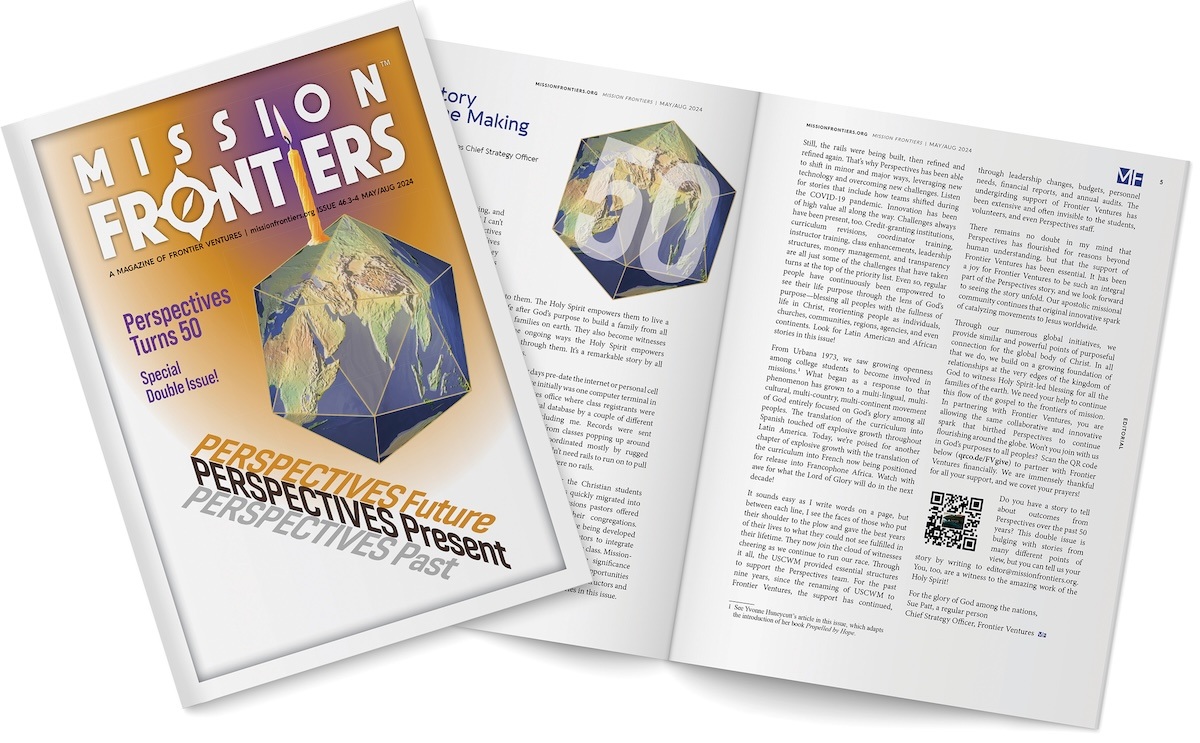
The ideas contained in the Perspectives curriculum have been powerful change agents across the mission enterprise. Look at the May-August 2024 Mission Frontiers issue celebrating that program’s 50th anniversary to gain a better picture of its impact.
Not only have individual lives been forever redirected, churches and denominations have refocused their energies, and many new agencies have been formed across the globe toward seeing the gospel of Jesus made available in culturally relevant expressions of community. Of course, Perspectives has not been the only thing going on through the USCWM.
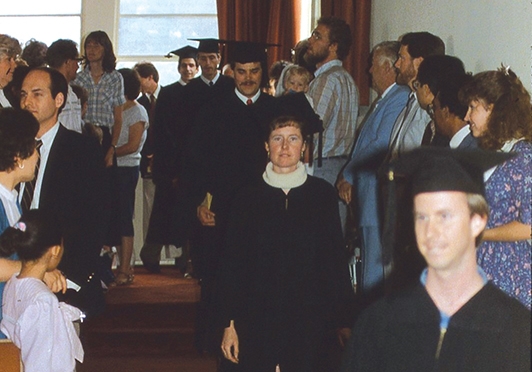
Not long after the USCWM was launched, William Carey Inter-national University (WCIU) was also founded by Dr. and Mrs. Winter to provide keen skills to future field workers who had in-tended to bring the gospel to places with least access to followers of Jesus. The early offerings included Community/International Development, Intercultural Communications and Applied Lin-guistics (TESOL), a course of study I began, but didn’t complete, as a single gal in the 1980s. Though there are around 450 alumni who did complete their studies, the magnitude of their influence over decades of service across the globe far outweighs the significance of the number of students. Many of these students completed their studies from countries in the non-Western world, ready to put their learning into action in real time. They are an extremely talented and dedicated pool of global leaders.
Building momentum toward the completion of the Great Commission has taken many forms over these 50 years. Much effort was driving toward the year 2000, and perhaps in our best, task-oriented intentions, the global mission enterprise participated. There were watchwords such as “A Church for Every People by the Year 2000” and initiatives such as the “AD 2000 Movement,” later adjusted to the “AD 2000 and Beyond Movement.” I wonder if the Lord was pleased to see the mission efforts of the Church continue beyond the year 2000 if just to ensure he would be the One leading, rather than we task-oriented Westerners.
We couldn’t have imagined in 1976 how the Spirit of God would continue to inspire and equip the two-thirds world to take their place as leaders in the global mission enterprise, but that has certainly been the case. Through persistent involvement in dissemination of ideas through education, publishing, and global gatherings, those with whom we collaborate reflect an increasingly diverse community of devoted Jesus followers. It’s astounding to see when we stop long enough to acknowledge this reality.
William Carey Publishing (WCP), Misson Frontiers (MF) magazine, and the International Journal of Frontier Missiology (IJFM) have been a big part of the dissemination of ideas through the USCWM and now Frontier Ventures (FV). Our staff has listened carefully to voices from all corners of the earth to discern trends and fruitful practices to see the kingdom of God move forward. WCP has published over 500 titles and sold more than 1 million mission books over its more than 55-year history. Misson Frontiers has published more than 275 issues highlighting a wide array of topics relevant to people interested in the global mission of the Church. The IJFM has been stimulating and provoking deeper thinking on mission topics for more than 40 years. There is no way to calculate the cumulative effect of all the words published, and that’s a good thing. We dare not take credit for fruit that could only come from the blessing of God.

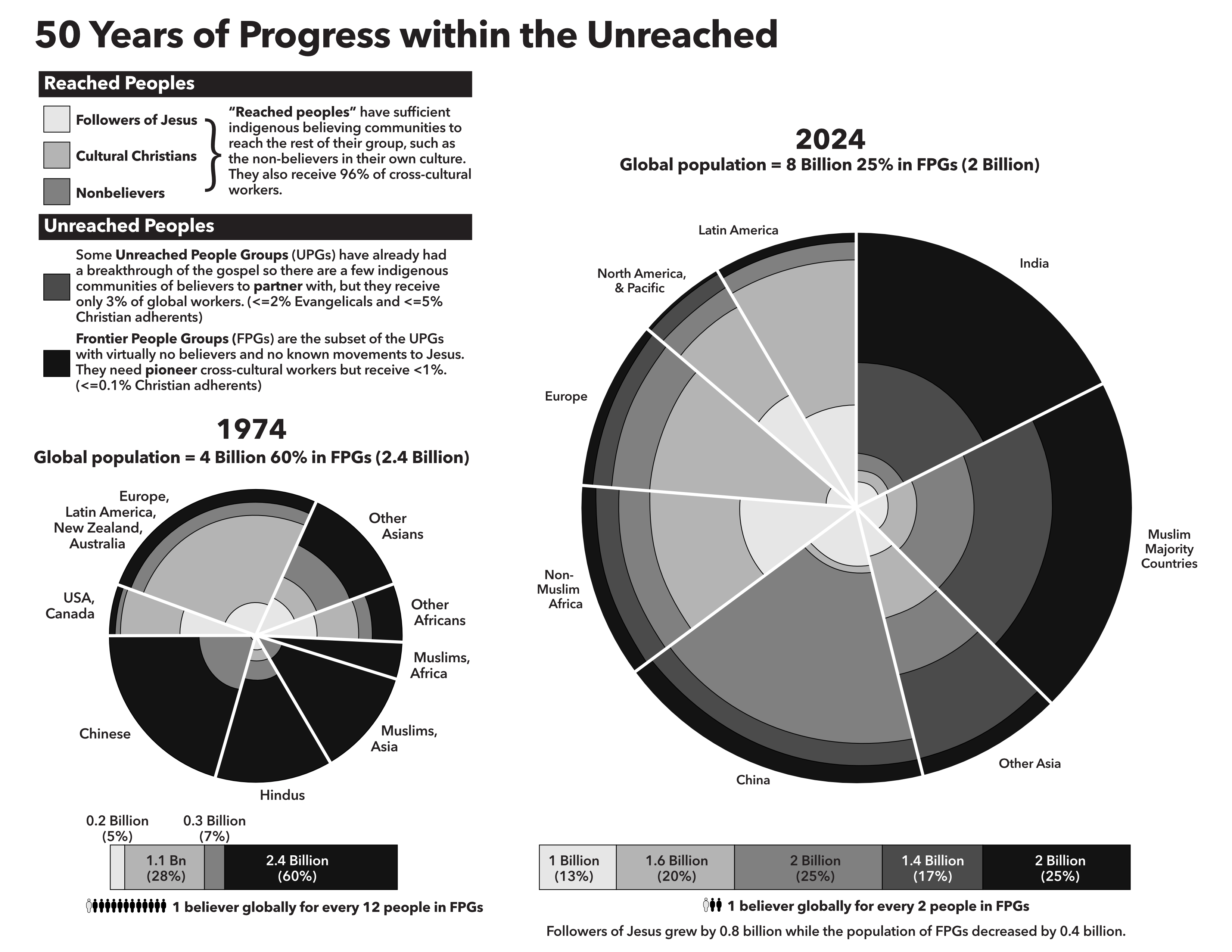
The fruitfulness of the mission enterprise is a glorious reality over the past 50 years. The view of world evangelization has been getting clearer as the global Church has also grown and there are more researchers carefully watching progress in kingdom growth across the globe. Where 50 years ago we estimated a total number of unreached people groups to be 16,750, today the estimated number of unreached people groups is around 7,250, with the greatest need represented by peoples in the Indian subcontinent. The way we see the unfinished task has gotten clearer, bringing adjustments to the view of all people groups globally, but this is no shell game of statistics. There has been unprecedented progress in world evangelization within the past 50 years. My favorite data crunchers are my friends at Joshua Project who manage joshuaproject.net, where you can see resources such as the “Status of World Evangelization 2024.” Only by God’s empowerment can this progress be explained.
Yet kingdom advance has come at a high price. Many communities of Jesus followers suffer greatly at the hands of those who are threatened by the good news Jesus brings. Many workers have paid a terrible price personally when they have come to the end of their own spiritual resources and run dry in their service to God. Missionary attrition has caught our eye as a barrier to gospel advance, and we have developed more resources to deepen our well of living water, to strengthen our connection to the vine spoken of in John 15. There is no substitute for abiding in Christ. It is essential for fullness of life, and field workers living among the least reached need a full tank of living water for their fruitful service. Our spiritual formation offering, Second Half Collaborative, (https://2hc.life/) was created to give field workers a deeper bucket, so to speak, to continue in the second half of life.
I was in the first cohort of this sweet community five years ago.
For 50 years the USCWM, now Frontier Ventures, has kept our gaze on the completion of the Great Commission of Matthew 28:18–20. That will not change. There have been ways the global landscape has shifted, and we endeavor to remain nimble to respond to change. Consider for a moment how the internet has changed the landscape, or how artificial intelligence is changing the landscape again. In 50 years, we have witnessed incredible evidence of God’s work in his world through our efforts, and we want to celebrate and recount his glorious deeds in our midst. So, tell us your part of the story. I will offer four quarterly virtual gatherings for alumni staff and collaborators to tell stories. Take a couple of minutes to connect with us through this form: https://forms.office.com/r/aSwNjJ1pei. We may want to publish what we receive so keep an eye out for more all year about our 50th anniversary!

1 The USCWM changed its name in 2015 and now goes by Frontier Ventures (FV).
Author
SUE PATT
Sue Patt has been on staff with Frontier Ventures since 1982. She lives in the Philadelphia suburbs with her husband, Fran. She is passionate about seeing God’s glory displayed among all nations.
Subscribe to Mission Frontiers
Please consider supporting Mission Frontiers by donating.
Subscribe to our Digital Newsletter and be notified when each new issue is published!