
Fifty years ago, my dad and mom, Ralph and Roberta Winter, founded the US Center for World Mission (USCWM), now called Frontier Ventures (FV). We four daughters asked my dad, before he died in 2009, not to burn his 50 journals but to let one of us go through them and choose what might be worth saving.1 Since I was the one who had the journals, when I was asked to write this article, I asked myself what were the values and convictions of my parents that gave birth, personality, and character to this organization?
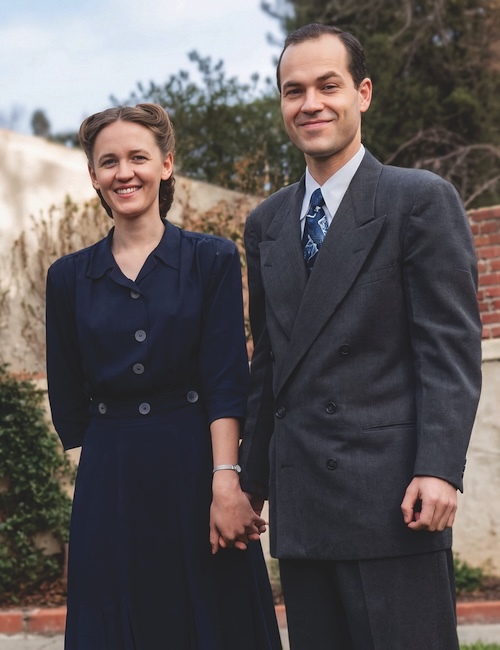
Ralph & Roberta just after they were married in 1951.
Let the Youth Lead
Memories and vivid images crowd into my mind. My dad grew up in a home with parents who had come to vibrant faith through Christian Endeavor,2 a youth movement begun in the 1880s. Christian Endeavor (CE), patterned after the YMCA and the Boy Scouts of America, emphasized leadership by the youth and meaningful service to the wider community.
These values became instinctive for my father through his own participation in CE and were later reflected in Frontier Ventures (FV). It began with a seminary professor, his family, and a ragtag group of volunteer students trying to raise $15 million for a campus focused on people groups with no access to the gospel. The young people had to step into leadership roles because we had no one else. Over the last 50 years, FV has consistently given leadership roles to passionate, energetic, creative, and faith-filled young people.
Do What Others Are Unable or Unwilling to Do
One example of the kind of community service modeled by CE was when my grandparents hosted an Afghan exchange student for two years in their home in South Pasadena, California. My father was still in high school and there were perhaps only five Afghan students in this country at that time.3 Because of this, my father and his older brother had an early awareness of a remote Muslim country and a desire to serve there.
World War II erupted during my father’s engineering studies at Caltech. The US Navy was losing fighter pilots at an alarming rate in the Pacific, so my dad enlisted and volunteered for the Navy V-12 Pilot program while finishing Caltech. He based his decision on something he learned in the Navigators:4 when choosing between two valuable, even crucial courses of action, do what others are either unable or unwilling to do. This has been characteristic of the vision of FV.
Prayer and a Love for the Word of God
When my dad married my mom, he benefitted greatly from her Wesleyan holiness upbringing. My mom grew up a devout Nazarene and learned from her mother to hear and obey the voice of God. A midnight time of urgent prayer on my grandmother’s part turned out to occur at the exact time my mom’s brother’s navy ship in WWII had been torpedoed—it narrowly missed his ship. This conviction—that we can hear even specific details from the Lord as to what to pray, and that he answers those prayers, sometimes spectacularly—continues to be a major value of FV.
A value that Dad brought to FV was his love for the Word of God and his commitment to discipleship. When he enlisted in the US Navy, he joined a Dunamis Club of the Navigators which met in the home of Dawson Trotman (founder of the Navigators) in South Pasadena. After my dad died, we found tiny boxes of cards with memorization verses and small notebooks from the early 1940s filled with Navigator Bible studies and lists of people to disciple.
After Caltech, Dad spent a semester at Prairie Bible Institute in Alberta, Canada, where he was captivated by L. E. Maxwell’s emphasis on the simple lifestyle and the Inductive Bible Study Method.5
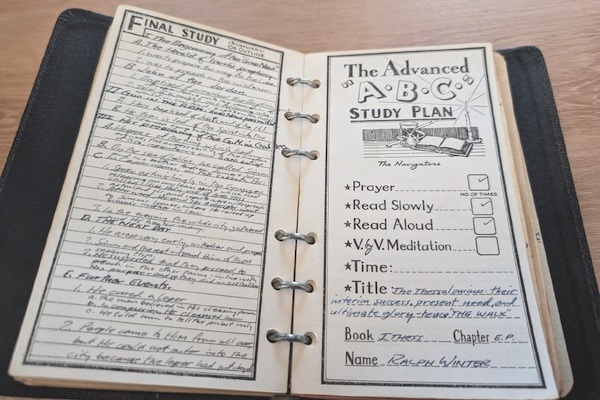
Ralph Winter's Navigators Bible Study and Discipleship Notebook, 1945, from the collection of his private journals.
The focus on discipleship, as well as the simple lifestyle, and the Word of God, were also front and center in the beginning of FV. We started every workday—the daily morning meetings—in the same small group, sharing from our personal quiet times in the Bible. My parents and the young staff were struck by the Moravian commitment to prayer6 and launched a 24/7 prayer discipline that staff would sign up for in four-hour shifts. Some of those profound, quiet moments in the middle of the night are still sacred memories for me.
Today, FV carries on this commitment to growing in Christ—we meet weekly in covenantal and contemplative communities. We also offer the Second Half Collaborative (2HC) program7 to our own staff, as well as other career missionaries, bringing them into small online communities with a spiritual director and a cohort who draw closer to Jesus together. I’m so thankful our organization makes it a priority to help people serving in mission to grow deeper in the Word of God and to experience the fullness of Christ both spiritually and emotionally. A vision and purpose without the water of life overflowing in our souls can simply become a yoke that is too heavy to bear.
Seize Unusual Opportunities
After the war was over, Dad went to Princeton Theological Seminary with his best friend, Dan Fuller, son of the future founder of Fuller Theological Seminary. Fellow Princeton Seminary students and good friends included Bill Bright, founder of CRU and J. Christy Wilson Jr., a missionary kid from Iran who spoke fluent Persian and later served in Afghanistan. Many years later, in 1977, CRU was one of the first organizations, along with Wycliffe Bible Translators, to donate $100,000 to help launch FV.
One day my dad woke up to read that the country of Afghanistan had put a full-page ad in the NY Times asking for 100 English teachers. Right away, he saw the potential for sending devout believers to Afghanistan to take up this task. In 1946, he and Christy Wilson attended the first Urbana Missions Conference of the InterVarsity Christian Fellowship in Toronto,8 full of ideas for recruiting 100 English teachers, themselves included.
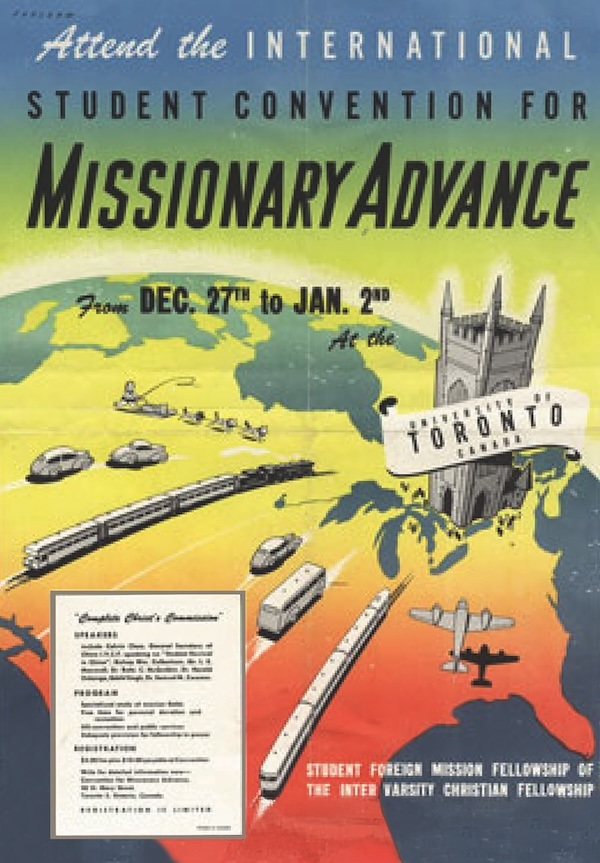
Poster advertising the first Urbana Student Missions Convention in Toronto, 1946.
Later Daddy would tell us four girls that this type of a high-level request from a remote country had happened centuries before as well: Kublai Khan, Emperor of the Mongols, whose land stretched from China to Iran, had a Nestorian Christian for a mother, and he sent word to the Pope asking for 100 teachers of the gospel to come to his empire.9
By this time, Dad and Mom were married and assigned to go to Afghanistan as teachers of English. But the Personnel Director for the Presbyterian Mission Board called them one day and said, “We’ve had a request from the highlands of Guatemala for a man with a PhD in Linguistics and Anthropology who is also an ordained minister and a wife who is a registered nurse. We don’t have anyone else who fits the bill. Would you be willing to reconsider your placement?” And so, they did.
Need for a Holistic Gospel and an Indigenous Church for Marginalized Peoples
The first two of Dad’s journals were in Spanish, written while our family was in Guatemala. As I translated them, I realized that many of his instincts and the values of FV came from my parents’ experiences in Guatemala—a beautiful country with volcanic lakes, heavily forested mountains, colorful handwoven costumes, and 22 super-complex Mayan languages. But it was also a country afflicted by the most extreme poverty we had ever heard of. Children were stunted in their growth for lack of protein. Some of the causes of this extreme poverty included the severe soil erosion and depletion but also the rampant alcoholism,10 seemingly devastating every single Mayan family in our region. It was a country in despair.
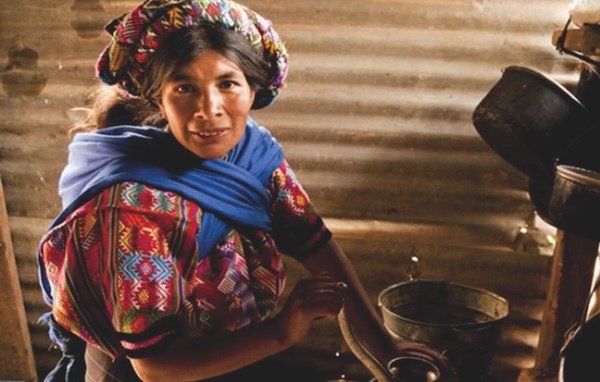
Indigenous woman wearing the traditional handwoven traje characteristically different village by village.
The journal entries made one thing immediately obvious: You couldn’t teach the Bible when people were starving to death. You couldn’t train Mayan men for the pastorate when their communities couldn’t support them financially. You couldn’t train farmers to be pastors when they could barely read. Kids were pulled out of school at third grade to help their families survive.
Pastors would need to be bi-vocational. What was needed was overwhelmingly complex: jobs, vocational training, deliverance from alcohol addiction, agricultural innovation, investment in small businesses for the women, rural health care, and access to education for children and especially for adults that would not pull them out of their commu-nities. My dad started 17 different small businesses and taught the double-entry system of accounting to the pas-tors-in-training.
My father had become convinced that the western highlands needed pastors who were Mayan—men who knew and understood their own languages and cultures. They needed Bibles in their own languages and parishioners who could read. Along with two of his Presbyterian colleagues, Jim Emery and Ross Kinsler, my dad started extension elementary and high school classes with itinerant teachers and, later, Theological Education by Extension.11
This understanding of the need for a contextually sensitive and holistic gospel led not only to the founding of a unique mission agency (FV) but also the William Carey International University (WCIU), originally a secular university established to look at the deep holistic needs of those people groups being highlighted by FV. To this day, even though FV and WCIU are separate institutions, they share similar goals and collaborate.
Missiological Innovation Through Collaboration
In 1966, my family moved back to southern California so my dad could take up the role of professor at Fuller’s new School of World Mission (SWM). Many of FV’s values emerged at that school: These included emphasis on unreached people groups, the understanding of movements to Christ, the focus on the anthropological study of culture, and the need for contextualization.
None of these values arose in a vacuum and none of them should be credited to my father alone. They were developed in a spirit of collaboration, especially hearing from people on the field—what was working and what wasn’t. Many of the SWM professors were engineers; others were outstanding anthropologists. It was a heady combination. This emphasis on innovation and collaboration is still evident in FV.
One example of innovation through collaboration comes from a journal entry. In 1965, my father was sitting in an adult Sunday School Class at Lake Avenue Congregational Church in Pasadena taking notes on a talk about peoples of the world with no access to the gospel given by Ted Engstrom of World Vision and MARC (Mission Advanced Research and Communication). He painstakingly copied all of this data and concluded that 87% of the world’s people lived in groups and languages which had no missionaries, no indigenous churches, and no access to the gospel; 90% of the world’s missionaries were working with already existing churches; and most of the frontier or “hidden” people groups were Muslim, Hindu, Buddhist, or Tribal.12 Fifty years later, the 87% has fallen to 25%, which shows wonderful progress, but the other two statistics are still true.
These conclusions caused Billy Graham to invite Donald McGavran and Ralph Winter to speak at the 1974 Congress on World Evangelization held in Lausanne, Switzerland. My father and his fellow engineer colleagues at the SWM had begun to ask why peoples in these cultures hadn’t come to faith. What were the barriers? What might be some of the solutions?
These startling facts were emerging in the mid-1960s when it had been widely believed that missionaries were no longer needed anywhere in the world. A decade earlier, much of Africa and other countries had thrown off their colonial overlords and declared independence. The prevailing conclusion was that there was no longer a need for missionaries, and that, in fact, missionaries had been agents of oppressive colonialism—something that was regrettably true in some cases. However, this worldview lacked an understanding of the immense good that had come to indigenous peoples with the translation of the Bible13 into their own vernacular languages, according to African missiologist Lamen Sanneh.14
This was a defining moment. It led to collaboration on a much bigger scale. Afterwards, my father would say that he wasn’t sure people listened or understood. But it changed him forever and gave birth to FV. Today, FV has extended this vision to identifying barriers and seeking solutions that lead to multiplying communities of Jesus Christ followers among the least-reached (or frontier peoples), especially those among Muslims, Buddhists, or Hindus.
“I will also…”
FV was birthed out of a passion to see Revelation 5:9 come to fruition:
You are worthy to take the scroll and to open its seals, because you were slain, and with your blood you purchased for God persons from every tribe and language and people and nation.
My father’s personal life verse was Isaiah 49:6:
It is too small a thing for you to be my servant to restore the tribes of Jacob and bring back those of Israel I have kept. I will also make you a light for the Gentiles, that my salvation may reach to the ends of the earth.
Imagine the prophet Isaiah saying that to a vanquished, enslaved people in exile. Despite the longings of their heart to return to the promised land, to rebuild the city of Jerusalem, and to rebuild the temple, God was saying that was too small a thing.
But God added, “I will also.” That’s the key. He’s not saying the first things that come naturally to our hearts are not valid prayers. He’s saying to enlarge our hearts because his heart is larger; he has other lost sheep, other lost pearls, other lost children that need to be rescued and restored to their families.
Can we still hear that today? In addition to all the needs of our own families, our local communities, our own nations, God still wants to send us—some from every fellowship of believers all around the world—as a light to the nations so that his salvation may reach the ends of the earth.
1 Thirty-five of Winter’s journals are already housed at the Ralph D. Winter Research Center (RDWRC), and another 15 will be joining them shortly. The RDWRC is jointly sponsored by William Carey International University and Frontier Ventures. Their website: rdwrc.wciu.edu/
2 “The society grew rapidly and soon spread to all the states of the United States and many other countries as well.” asburyseminary.edu/elink/ the-christian-endeavor-collection-1/. See also this 1925 article in Time Magazine about the influence of Christian Endeavor: time.com/ archive/6818810/religion-christian-endeavor/.
3 www.library.illinois.edu/slc/illini-everywhere/afghan-illini/.
4 www.azquotes.com/author/24943-Dawson_Trotman.
5 www.thefreelibrary.com/The+legacy+of+Leslie+E.+Maxwell.-a0119613646.
6 “As is so often the case in church history, the onset of revival only deepened the Moravians’ commitment to the power of prayer. As amazing as it seems today, the Moravians kept up their round-the-clock prayer ministry for over a century.” Nathan A. Finn, “The Hundred-Year Prayer Meeting,” Desiring God, www.desiringgod.org/articles/the-hundred-year-prayer-meeting.
7 2hc.life/
8 “Finally, on Friday, December 27, 1946, the first IVCF missions conference began. Approximately fifty-two denominations were represented by 576 students from 151 colleges, universities, and seminaries. Long after the conference concluded on January 2, Stacey Woods noted that more than half of the participants had indeed gone to the foreign mission field (including Jim Elliot, David Howard, and Ralph Winter), with the other half actively supporting missions from home.” www.cslewisinstitute.org/resources/life-of-j-christy-wilson-jr-1921-1999-and-his-worldwide-discipling-ministry/. See also Wilson’s biography Where No One Has Heard: The Life of J. Christy Wilson, Jr by Ken Wilson.
9 Go to this link to read the story: www.getreligion.org/getreligion/2019/7/18/8h7gtewx966sc2433fbyjvdtnjeh1k.
10 “For as long as people could remember, alcohol abuse had been widespread in Guatemala. All the communities in the PUA [the right-wing political party] had at least one Alcoholics Anonymous, and alcohol abusers were called a range of names such as bolos, charamileros and chibolas.” Cathy McIlwaine and Carol O N Moser, “Drugs, Alcohol, and Community Tolerance: An Urban Ethnography from Colombia and Guatemala,” odi.org/en/publications/drugs-alcohol-and-community-tolerance-an-urban-ethnography-from-colombia-and-guatemala/ “Guatemala reportedly has the 4th highest rate of alcohol-related deaths in the world, even though it has one of the lowest rates of consumption in Latin America.” medium.com/@samdunlopdoyle/alcohol-abuse-and-violence-against-women-in-guatemala-338ca5842a2d.
11 “The Origin of Theological Education by Extension,” teenet.org/blog/origin-theological-education-by-extension/.
12 See “Major Concepts of the Frontier Missions Movement” by Alan Johnson in the International Journal of Frontier Missions, 18:2, pp. 89–96.
13 Andrea Palpant Dilley, “The Surprising Discovery about Those Colonialist, Proselytizing Missionaries,” Christianity Today, Jan/Feb 2014, www.christianitytoday.com/2014/01/world-missionaries-made/.
14 The most salient point Sanneh makes is that vernacular Bible translation outdistanced and outlasted the ephemeral forces of colonial rule. More importantly, vernacular Bible translation and all the structures that support it effectively empowered local peoples against their colonial overlords.” Yancy W. Smith,
“Lamin Sanneh’s Translating the Message: The Missionary Impact on Culture,” in MisseoDei’s Book Review, Winter/Spring 2018, missiodeijournal.com/issues/md-9-1/authors/md-9-1-smith. See also Lamin Sanneh, “Christian Missions and the Western Guilt Complex,” The Christian Century, April 8, 1987
Author
Elizabeth Winter Gill
Beth Gill (BA Linguistics UCLA) grew up in the highlands of Guatemala with her missionary family. She and her husband helped launch the USCWM. They then spent 12 years in North Africa in ministry to Muslims. She serves on the editorial team of the International Journal of Frontier Missiology and is on the board of directors for Frontier Ventures. She has four adult children.
Subscribe to Mission Frontiers
Please consider supporting Mission Frontiers by donating.
Subscribe to our Digital Newsletter and be notified when each new issue is published!