
I wanted to become an architect since I was 15 years old. During my second year at university, God made it clear that he did not want me to be an architect but wanted me to help build his Church. I knew it was the Spirit, but I didn’t understand what it meant, only that it had something to do with missions. I began building relationships with international students and eventually earned a degree in anthropology because my discipler convinced me I could find something even at our secular university to help fulfill my calling. It was some of the best advice I ever received.
I hadn’t learned much about missions at home, church, or school. I knew little about the biblical mandate for mission beyond a few verses in the New Testament. I did not know that God had revealed his purpose to bless all the families of the earth through Abraham long before Sarah gave birth from her barren womb. I did not realize that the messianic promises and the necessity of the cross are part of a greater narrative to glorify Jesus within every segment of humanity. I had no idea about the status of world evangelization and the great harvest happening even then in the majority world.
Most Americans, including myself, saw Christianity as under attack and losing ground. I just knew that God wanted his people to be his witnesses to the world, and I was willing to be one.
Awareness Brings New Hope
A shift towards hope began when a close friend volunteered at the US Center for World Mission (USCWM) and made me aware of the many resources coming out of Pasadena, such as the Caleb Declaration, Mission Frontiers, and the Global Prayer Digest (then the Daily Prayer Guide).
At Urbana, I received a piece of paper that cost pennies to print but changed the trajectory of my life. I studied the 1980 pie chart, Penetrating the Last Frontiers, which I hung on my wall—it haunted me. I asked myself, “How could there be so little progress in vast swaths of humanity nearly 2,000 years after Jesus commissioned his Church to reach the world? Why did nearly all missionaries go to cultures where churches were already established? How can you make disciples when so many do not have the Bible in their own language?”
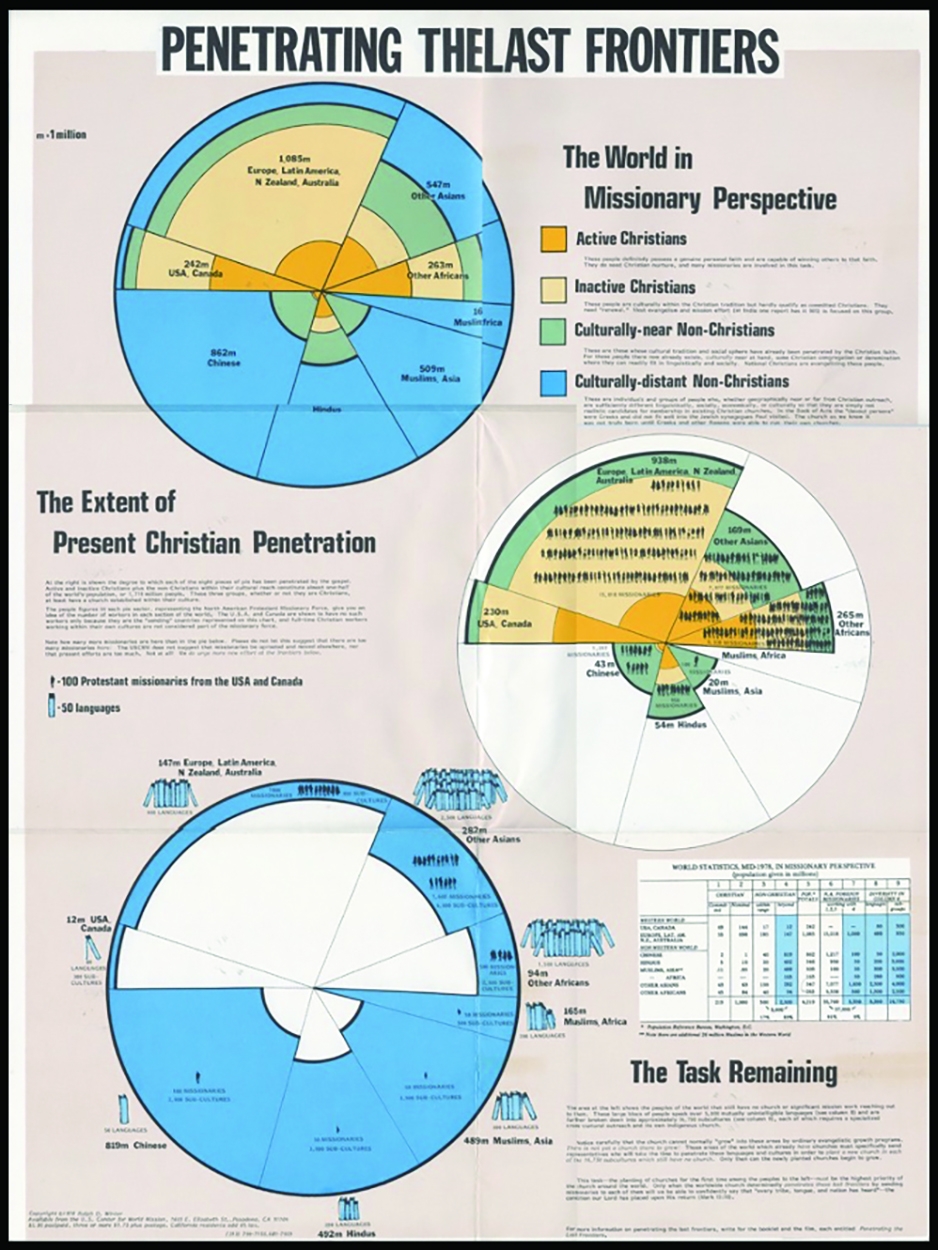
Those questions led me to study the history of Islam and to train in Muslim evangelism. I was on my way to becoming a church planter, or so I thought.
I married Linda partly because she had lived among Muslims in Senegal during her time in the Peace Corps and was willing to go anywhere with me. We took in a disabled foster son, which, at least in the short term, would prevent us from serving overseas. We decided to spend “three to five years” at the US Center for World Mission to prepare for living and working among Muslims. That never happened. Instead, we have been involved in mobilizing others to go to the nations for 38 years.
Ground Zero
Those who worked at “the Center,” as we called it locally, recognized that we were participating in a massive paradigm shift for the Church. Clearly, God was doing something new, and the USCWM in Pasadena was ground zero for an emerging global movement.
Two things stood out to me that captured the attention of the global church. First, the challenge the USCWM presented was so immense and the world so complex that simply adding one more organization to the mix wouldn’t help. The irony of starting an organization aimed at sending workers to the unreached that did not send missionaries actually made sense. Collaborating with other organizations was essential for success.
The second and most compelling message from the USCWM was that God had given his Church a task that could be finished. It is the only mandate in the Bible that can be completed. We will never be done with all the “one anothers,” but one day Jesus will have worked through his people to make disciples within every people.
As an engineer, Ralph Winter did the math and urged the Church to envision that “a church for every people” was possible “even as soon as the year 2000.” This concept of closure within our lifetimes captivated the global Church and galvanized countless commitments from individuals and organizations wanting to do their part.
Recruited to a Cause
We arrived in Pasadena in August 1988. Earlier that year, they made the last payment on the campus. At that time, the staff was largely comprised of older missionaries of retirement age and young people who had come to establish this collaborative mission base. Many arrived thinking they would stay for a few months but ended up staying for years. Others left once their reason for coming was fulfilled.
One of the great aspects of working in a nonprofit is that its vision always exceeds its capacity, creating persistent staffing gaps. What’s great about that, you ask? Young people like me, who lack enough life experience to know their strengths, are thrown into those gaps.
Having always been a utility player, I was thrown into many different roles: recruiter, support-raising trainer, personnel director, vice president of business affairs, software programmer, and ministry accounts manager. I discovered what I excel at and, more importantly, what I do not.
Since 1997, I have served full-time with Perspectives as an editor, author, and program developer, culminating in my current role as the director of the Perspectives Global Service Office.
Ralph Winter realized he was not simply establishing a new organization but creating a living, breathing multigenerational community of believers who were covenanting together for a purpose greater than themselves. This covenantal commitment required doing things many of our peers were unwilling to do. There was an explicit challenge to prioritize the cause of Christ over personal career development and ambitions. Dr. Winter once said, “I would not walk across the street to recruit a missionary, but I would travel around the world to recruit someone for the cause.”
The USCWM attracted many talented young people, most of whom could have pursued more financially rewarding careers. Our involvement was much more than a job; we knew we were changing the world and fulfilling history.
A Protestant Missionary Order?
To become a member of the US Center for World Mission, you had to not only be willing to raise your salary, but you also had to be willing to join a Protestant missionary order. Dr. Winter observed that Catholic orders maintained continuity of purpose over centuries and realized that Protestant mission agencies served a similar function.
The idea of living within an order was uncomfortable for highly individualized Americans raised to believe that once they graduated from high school, they were on their own and rarely accountable to anyone. I don’t know anyone who would say they valued or enjoyed all our community practices, but they solidified our shared identity and set us apart from Christians who merely attended churches.
As members of the order, we needed permission from our families to join, joined as couples if married, were paid based on need rather than position, and were committed to helping others and receiving help in return. We agreed to participate faithfully in the routines, or “regulae,” that defined our shared life. These routines included daily fellowship in small groups, morning meetings, bi-weekly missiology meetings, a bi-weekly interface between campus ministries, and the Thursday night Frontier Fellowship, which was open to anyone and featured guest speakers sharing recent works of God around the world. These regular meetings were in addition to our four-hour shifts in the 24/7 prayer room, departmental meetings, and leadership meetings. We joked that USCWM stood for the “US Center for World Meetings.” While it was frustrating and time-consuming, it was effective in forming us into a community of world Christians.
A Unique Community
The larger USCWM/WCIU (William Carey International University) community was comprised of staff and families from dozens of collaborating agencies, schools, and churches. At its peak in the 1990s, it included 200 to 300 people, most living in university-owned homes within a few blocks of the campus. Despite working in different organizations, we shared a strong sense of community. Adults were “aunties” and “uncles,” and kids were closer than cousins, moving freely between homes where they were known, loved, and cared for.
Many things benefited the entire community, such as our missionary boutique, community meals, food banks, shared kitchens, rentable guest rooms, reservable meeting spaces, a full-service mailroom, special-interest prayer groups, prayer chains, the Extended Family Co-op (shared childcare allowing parents to do ministry), sports courts, community events, concerts, play areas, picnic areas, and campus-based schools for children. Visitors were always impressed by what a unique place it was to live and work.
However, the economics of living in Southern California steadily took their toll. Agencies struggled to justify remaining if their staff could not afford homes. Mission organizations were gradually replaced by unrelated schools and churches. Those who moved away universally cited the loss of community as the hardest part. We not only lived close to one another but were also there for each other: in prayer, to watch kids or pets, to help when spouses were out of town, assisting the disabled, sharing tools, equipment, and vehicles, and providing meals when needed. Most of us had a mental list of half a dozen people we could call for help at any time, day or night. That is almost unheard of in an era where most Americans live next door for decades without meeting their neighbors.
Forming World Changers
Even though the US Center for World Mission’s simple message was the plight of the unreached peoples, we quickly learned that the mission of God is a profoundly complex endeavor with implications for nearly every aspect of human existence. Dr. Winter understood that if those he recruited were to change the world, they themselves needed to be transformed by the realities of the world. I don’t know of any other organization that expected staff to open and close windows, use fans, and acclimate to the summer heat “because the majority of the Church does not have air conditioning.”
The work we do through Perspectives opens believers’ eyes to the “all peoples mandate” and invites them to join the world Christian movement. However, what I appreciate most about Frontier Ventures (formerly the USCWM) is not just the introductory material, but the ongoing deep missiological reflection that draws insights and innovations from apostolic visionaries relentlessly seeking ways to overcome barriers to movements toward Jesus in specific contexts. A shout-out to those who publish these insights for the whole Church through Mission Frontiers, the IJFM, William Carey Publishing (missionbooks.org), and the Mission Drop podcasts.
It Takes Community
Building the Church means bringing in the fullness of Abraham’s faith family from every people. He will be a “father of many nations.” It also means envisioning and empowering the Church to fulfill that vision.
In 2007, I stood on a stage on a hot day in a non-air-conditioned meeting hall in Jos, Nigeria giving an update on the status of world evangelization to hundreds of Perspectives alumni. While I spoke, the Spirit whispered in my ear, “Do you remember when I told you that I did not want you to be an architect, but to build my Church? This is what I meant.”
Perspectives has produced over 350,000 alumni in more than 40 countries and 9 languages and is rapidly multiplying. I do not claim credit for this growth, nor does anyone else involved. It has been the wind of God in the sails of many ships built by communities of countless believers committed to him, to one another, and to the glory of Christ within all peoples.
Author
BRUCE KOCH
Bruce Koch has served with Frontier Ventures since 1988. He has been the director of the Perspectives Global Service Office since 2012. He has been married to Linda for 42 years and has four adult children.
Subscribe to Mission Frontiers
Please consider supporting Mission Frontiers by donating.
Subscribe to our Digital Newsletter and be notified when each new issue is published!