
Miriam woke up in a cold sweat. The image of a man dressed in white and shining like the sun was scorched in her mind. It was far from the first dream she had ever had, but this was different. It was like the dream reached out from her sleeping mind right into the real world.
“Find this book,” the man in white had said, handing her a strange tome. “It will show you the Way.”
What could the dream possibly have meant? She needed some tea. Groggy, she lumbered from her bedroom and into the common area of her apartment. But before she could flip on the kettle, something stopped her in her tracks. There, on the coffee table was the exact same book from her dream. She could tell because of the strange, golden letters printed on its spine: B-I-B-L-E.
There’s an App for That
At Waha, we love Miriam’s story, because it reminds us of all the ways God works. He reveals himself through miraculous dreams and visions, but also through human innovation.
Waha is a not-for-profit whose mission is to empower people everywhere to become disciples who multiply disciples among the unchurched and unreached. We do this through technology. Our app facilitates a Discovery Bible Study and disciple-making course with the push of a button so anyone can lead one with almost no training or expertise whatsoever. It’s easy to see why we get excited about God meeting people through technology.
Take Miriam, for example. As a refugee in a Middle Eastern city, she had little access to gospel materials. But when she saw her roommate’s Bible on the table, she knew she had found something real. Before long, she was sitting in her roommate’s house church, discovering God’s Word herself.
“We have always been told this book is only for Christians,” she said once. “But it’s not. It’s for everyone!”
She wanted to share with all the Muslims she knew but struggled to communicate clearly. That’s when the leader of her house church told her how to download Waha on her phone. All she had to do was invite friends to join her for a meeting and then push the play button. The app read a story from the Bible, asked a question about the story, and made a tone, signaling for her to press pause and discuss the answer with her group.
A Theology of Technology
Technology has a role to play in missions, but many can be forgiven for suspecting its trustworthiness. We live in a time when technology meant to connect us has instead sown deep division in our societies,1 even to the point of inciting violence.2 When we innovate new technologies to aid missionaries, how do we avoid unintentionally creating something that does more harm than good?
Writing on the topic for the Lausanne Committee, Swiss theologian Stefan Lindholm offers a helpful theological framework. Because we are fallen yet made in the image of God, he says, “we must reckon with both the dignity and depravity of human beings due to the enormous impact technology can have.”3 Technology reflects our depravity when it isolates us, dehumanizes us, or molds us “according to the patterns of this world” (Rom 12:2). Technology reflects our dignity, however, when it creates community, encourages wonder, and helps conform us to the image of Christ (2 Cor 3:18).
Technology is an extension of ourselves but can also shape us. To better understand how it does, those who study media suggest we think in terms of hot or cold media. Hot media is high-information and requires less of the user, while cold media is intentionally low-information so the user is encouraged to take an active role in its use.4 When we innovate technologies for the mission field, we should ask ourselves: Is this hot or cold? Does it encourage active participation in the life of God or passive receipt of biblical truth?
Miriam learned about this when her movement exploded across the Middle East. It began one night when she was scrolling TikTok and came across a video of another Muslim woman sharing the exact same experience as her; a dream of a man in white telling her to follow him. Before she knew it, the algorithm had figured out she wanted similar videos and introduced her to young men and women across the Muslim world all talking about the same dream.
Miriam decided to reach out. She created a Whatsapp group and invited as many of the people behind these TikTok videos as possible. Before long, she had assembled an array of people from multiple countries in the Middle East and North Africa. When she told them how this mysterious figure is Jesus, they wanted to know more. So, she sent them a link and told them to download Waha.
She could easily have sent a YouTube video, a podcast, or even a sermon from one of the best teachers in the world, but these hot media would have required little of those in her Whatsapp group. The Waha app is intentionally designed to require a group of real people to sit together, read, discuss, and challenge one another to obey and share the Word of God. Not only does it require a great deal of participation from users, but it encourages the formation of communities around being and making disciples of Jesus. In this way, Waha lays the foundation for perhaps the most powerful form of cold media: the Church.
How Waha Makes It Easy to Catalyze CPM
David Garrison lists five key principles that contribute to the formation of church planting movements. They are:
1. Reproduction
2. Multiplication
3. Indigeneity
4. Churches Planting Churches
5. People Groups5
The people in Miriam’s Whatsapp group found it easy to replicate DBS with Waha because of its plug-and-play design. Each lesson asks how the group will obey and share what they have learned, so it encourages multiplication from the start. This eventually leads to house churches that plant other house churches, until a movement overtakes an entire people group. Perhaps the biggest challenge for an app is to encourage indigeneity, but that is why Waha has been localized into over 40 languages with nearly 50 more on the way.
Over time, Miriam’s groups matured. They made decisions to identify with Christ as a Jesus community, undergoing baptism as a mark of their faith. The disciples in these churches shared their faith and made other disciples until they, too, established themselves as churches. Before she knew it, Miriam found herself leading a multi-ethnic church planting movement spread across many nations in the Middle East and North Africa.
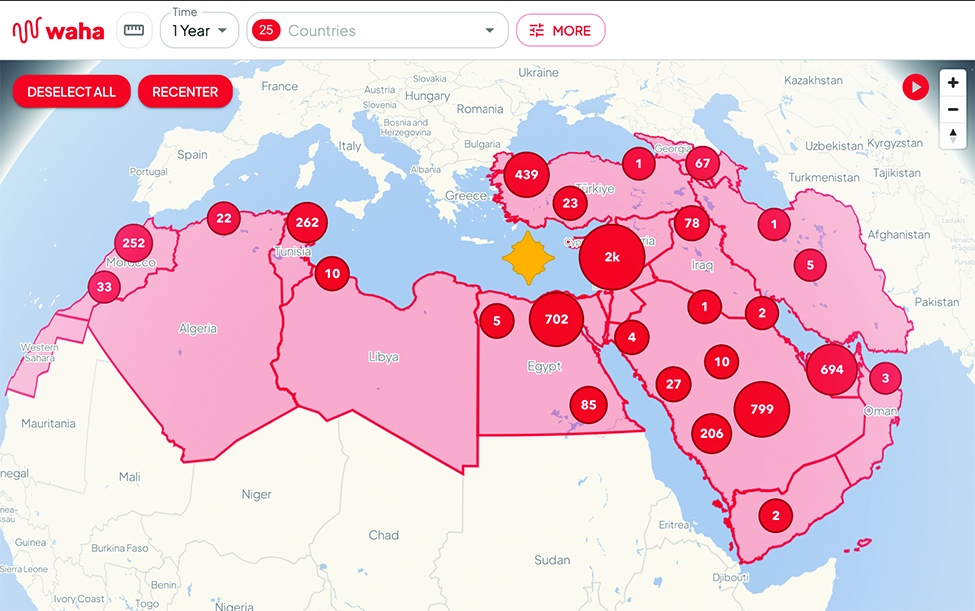
There is one city, she said, where virtually all immigrants are involved in some form of DBS, whether using Waha or not. Another of her stories tells of an Islamic extremist who began reading the DBS content in Waha in secret. One day, he was discovered by his comrade, but instead of facing consequences, he led his comrade to faith. Another story from the movement tells of a witch doctor led to faith by her grandson and planting a church with everyone she used to curse.
Conclusion
Innovation doesn’t just happen because we use a fancy new technology. It is a part of a continuous process of collective intelligence that brings the Body of Christ together to access the mind of Christ for the nations.6 We believe Waha is made better by users just like Miriam, who send in stories from all over the world and provide precious insights into new ways the tool can be made more effective. Some of the best ideas have arisen from the field among local believers like Miriam, who cannot reveal their actual identities due to security concerns, and for them we are truly grateful.
If you or your organization is looking to innovate new ways to use technology in Great Commission work, we hope our experience has provided meaningful insight. When we approach innovation with a healthy theology of tech, understand its formative effects on all of us, and encourage living discipleship communities as its bedrock, we are confident that the Body of Christ will see the most exciting and effective breakthroughs in our work to share the good news.
1 David Herbert and Stefan Fisher-Høyrem, eds., Social Media and Social Order (Warsaw: De Gruyter Open, 2022), 111. doi. org/10.2478/9788366675612.
2 Samuel Musa and Samuel Bendett, Islamic Radicalization in the United States: New Trends and a Proposed Methodology for Disruption, Defense & Technology Paper no. 77 (Washington, DC: US Department of Defense, September 2010). www.govinfo.gov/content/pkg/ GOVPUB-D5_400-PURL-gpo55900/pdf/GOVPUB-D5_400-PURL-gpo55900.pdf.
3 Stefan Lindholm, “Technology and Missions: How Technology Is Changing Our Lives and Why It Matters for the Great Commission,” Lausanne Occasional Paper (Lausanne Movement, 2025), lausanne.org/occasional-paper/technology-and-missions-how-technology-is-changing-our-lives-and-why-it-matters-for-the-great-commission#a-brief-theology-of-technology.
4 Marshall McLuhan, Understanding Media: The Extensions of Man, 5th printing (New York: Signet Books, New American Library, 1964), 36–38.
5 Garrison, David. Church Planting Movements: How God Is Redeeming a Lost World (Monument, CO: WIGTake Resources, 2004), loc. 245.
6 A.K. Amberg, “Success, Failure and the Mind of Christ: How Collective Intelligence Turns Our Losses into Victory,” Seedbed Journal 36, no. 2 (August–September 2025), 118.
Author
A.K. AMBERG
A.K. Amberg is a church planter and missiologist researching contextualization in church planting movements. He is a director at Waha, a company dedicated to empowering people everywhere to multiply disciples. Find out more at www.waha.app.
Subscribe to Mission Frontiers
Please consider supporting Mission Frontiers by donating.
Subscribe to our Digital Newsletter and be notified when each new issue is published!