
“24:14—Pursuing movements in every unreached people and place.”
In mission sermons and conferences, speakers commonly urge listeners to choose one of three standard responses: pray, give, or go. Others argue for pray-give-go-mobilize. But this doesn’t address the need for discipleship, and it reflects a pick-and-choose mentality.
My main concerns with these responses are captured in these two questions:
1. What does Jesus really expect of his followers, irrespective of place or position?
2. What can we discern from Jesus’ early disciples and their use of diverse callings?
Today, we must be asking ourselves continually, “How am I obeying the Great Commission? Am I truly living on mission as Jesus requires?” And, “Lord, how can I use my life to extend your kingdom to those with the least gospel access?”
Based on a decades-long career in missions, I recommend a four-stage model that better encourages all believers to meaningfully engage in global mission. It invites every believer to engage with Stage 1 and leads some all the way to Stage 4.
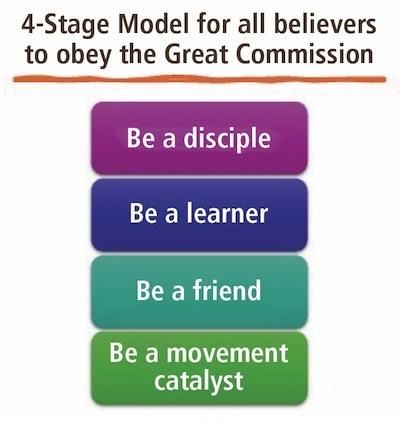
Stage 1: Be a disciple who makes disciples
The pray-give-go formula, even with mobilization added, still lacks the call for every believer to be a disciple-maker—an essential element of the Great Commission. I don’t believe it’s enough to say, “I’m just called to pray,” or “I’m a mobilizer.” A disciple of Jesus seeks to obey everything he commanded, including his last command to make disciples. That is indisputably the core of the Great Commission (Matt 28:19).
So, in Disciple Making Movement (DMM) trainings, we first consider whether we ourselves actually live as disciples, or whether we’re simply living as Christians or Christian professionals.
Then, if we dare to lean into God’s concern for all nations rather than ignore it, he often moves us to the next stage.
Stage 2: Be a learner of peoples, cultures, and God’s mission
As we grow in Christ, we begin to care for all people, including those who are very different from us. Jesus told a group of Jews that they would become global witnesses by the Spirit’s power. And they did. So, rather than requiring only mission workers to learn about other cultures, we should teach all believers to learn about the diverse people God brings across our paths—especially those from unreached areas. We all need to learn to live out God’s love and concern for all peoples.
So, if you frequent Pad Thai or Pho restaurants, pray for your servers and learn a little about Southeast Asia. Memorize a few phrases or greetings in their languages. If you realize a community of Somalis, Afghans, or Rohingya has moved in nearby, welcome them as neighbors and watch some YouTube videos about their countries and cultures. Play a pick-up soccer game alongside immigrants. They will welcome you! Teach English or find other ways to help newcomers. Such things could well be the way God leads you deeper among that people group, or a similar one.
Vision comes from knowledge and experience. It’s hard to care much about an unreached people group if we know nothing about them, have never prayed for them, and can’t find their country on a map. But if we develop relationships with people from other cultures, wherever we are, or begin to learn about a group, the Lord can lead us. It helps to do this while memorizing some key Bible verses relevant to missions, such as Psalm 96:1 or John 20:21-23. Perhaps your church focuses on a specific region or unreached group, or you have a friend who has moved into an unreached setting. Check it out and see where God may lead!
For some of us, however, learning about other people groups from the safety of home will soon feel insufficient. We want to go. But we shouldn’t go long-term if we’ve never made any disciples where we live now or done any cross-cultural ministry nearby.
Not everyone will feel led to move overseas as supported mission workers. Some will go as tentmakers, earning a living while intentionally residing in a spiritually needy area. Others will live overseas only for a short time. Most of us can learn by developing friendships with refugees who have settled in our city while enjoying outstanding hospitality along the way. But we all can honor God’s vision for all peoples by learning about them and praying. So, let’s live as disciples making disciples who continuously learn about God’s world and his mission. As we keep learning and praying for the people God brings along our paths, he may lead us to some creative and exciting next steps.
Stage 3: Be a friend of disciples across cultures
Friendship lays a foundation on which all ministry must be built, whether in compassionate outreach, evangelism, discipleship, or high-level strategic partnerships.
But being a cross-cultural friend in our modern era doesn’t necessarily require relocation. With modern tools like WhatsApp, email, and Signal, we can safely keep in close contact with people anywhere. Free time can be used for meaningful connections instead of binge-watching Netflix; vacations can be used for mission as well as fun.
When we intentionally choose to live relationally and missionally, the Lord can more easily guide us. God can use friendship in the gospel with like-minded disciples who share a God-given vision to reach a particular group. Together, you can learn how to support your friends wisely as the Lord leads you into unexpected encounters, places, and relationships.
Living as a friend can take you into both high and difficult places, and being a friend on mission is crucial to your effectiveness.
Stage 4: Be a catalyst of movements
When I first heard about church planting movements (CPMs), I couldn’t believe it. I had always dreamt of seeing such a thing happen in the area where I served, but I didn’t know how to get there. Then I began to learn how to catalyze a CPM through the strategy of disciple making movements (DMMs), and my life and ministry changed radically.
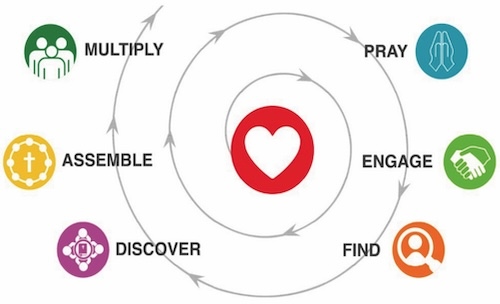
DMM strategy attempts to follow Jesus’ sending pattern as found in Matthew 9:36; 10:16; Mark 6:6, 13; Luke 9:1, 6; and Luke 10:1, 16. Practitioners frequently focus on several steps:
(1) Begin with extraordinary prayer.
(2) Go and serve the lost through word and deed.
(3) Seek people of peace (PoP).
(4) Form discovery groups (Discovery Bible Studies). In these groups, the PoP and their family can learn together about the way of Jesus.
(5) Nurture discovery groups to become (house) churches.
(6) Develop leaders to continue the process. (See DMM Spiral below.)
If you’ve not attended a DMM training, I wholeheartedly recommend it.1 Its principles can be fruitfully applied in any context.
Catalysts facilitate rather than being the primary ministry leader in a different culture.2 This involves a huge mind-shift. Ministry as a movement catalyst consists of casting vision, providing training, offering ongoing encouragement and coaching, building prayer support, and sometimes helping to provide external resources.
Many people living in UPG areas consider the people around them unreachable. They’re often unaware of what God is doing in similar regions of the world, which could greatly encourage them.3 We can tell them that God is doing a new thing in many places. He may do it in their area, too! Do you know a persecuted believer in a difficult situation? Or a supported mission worker in a UPG setting who is struggling? Perhaps you can help them catch a vision for a movement.
Helping your friends get DMM training is a crucial step toward catalyzing a movement. If you’re not a trainer, maybe you could bring one to your area. DMM trainers are multiplying worldwide, but the need is greater than the supply. So, I encourage you to learn DMM to the point that you can facilitate an introductory training yourself. If you find a receptive audience, you can then help them get follow-up training with a more experienced trainer later.
Conclusion
Our first and foremost task is making disciples. Let’s not lose sight of that. Then, as you make disciples, seek to become a lifelong learner of peoples, cultures, and God’s global mission. Be sure you learn not just intellectually but also relationally; be a cross-cultural friend. All the while, keep seeking God to help you become a catalyst of disciple making movements as well. He knows we need a lot more of them!
Of course, the Church must pray, give, and go. And mobilize. But we can do better. Let’s be disciple-making disciples who obey all Jesus’ commands and multiply his disciples everywhere.
1 Online training can be found at www.mercyalliance.org/.
2 See Wilson, Gene. Emerging Gospel Movements: The Role of Catalysts (Eugene, OR: WIPF & Stock, 2021).
3 See, for example, Coles, Dave and Stan Parks, eds.. 24:14 – A Testimony to All Peoples (Spring, TX: 24:14, 2019).
Author
STEVEN P. STEINHAUS (Pseudonym)
Steven Steinhaus ([email protected]) worked overseas with OMF, Frontiers, and Pioneers. Currently, he serves as a DMM catalyst and SE Asia regional director for New Generations. He and his wife, Joy, serve glocally from the Chicagoland area.
Subscribe to Mission Frontiers
Please consider supporting Mission Frontiers by donating.
Subscribe to our Digital Newsletter and be notified when each new issue is published!