
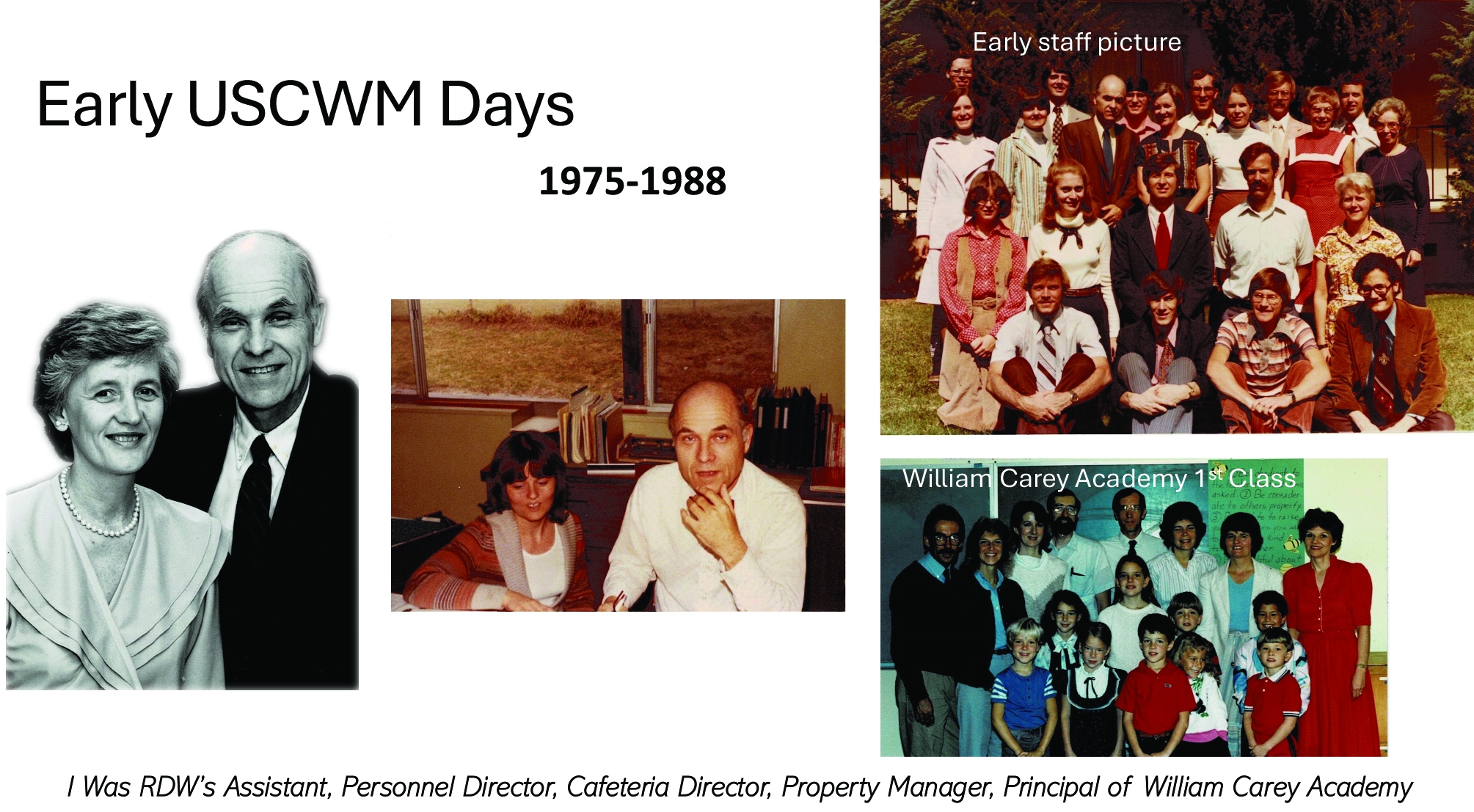
It was my privilege to be there in the early days of the founding of the US Center for World Mission—now known as Frontier Ventures.
I was the first staff member, starting even before day one, working alongside Ralph and Roberta Winter. I had many roles.
At that time, I did not know I was standing at the beginning of something that would shape mission history, as well as change my own worldview. I was not thinking, “This will reshape global missions.” I was thinking about mail to answer. Phone calls to make and return. Letters to send explaining the vision. New office spaces to arrange. Conversations that felt ordinary and yet somehow urgent all at once.
The details are not as vivid now as I wish they were. I cannot replay every meeting or reconstruct every conversation—though there were many.
Conversations with leaders like Billy Graham, Bill Bright, and Ed Dayton. Collaboration with Drs. Glasser, McGavran, Wagner, and Kraft. Interface gatherings every Monday with mission leaders who had offices on campus. Monday through Friday 8 a.m. prayer meetings. Thursday night community dinners. Meetings following dinner with visiting missionaries whose vision intersected with ours. Our children playing games on the large campus. Soccer games for staff on the soccer field after work.
But there were difficult times, too. Trying to understand the cult that rented the campus we were buying. Breaking their curses on us. Cleansing the spaces. Marching seven times around the campus in the spirit of Joshua taking Jericho.
A 9-to-5 job was never part of the imagination. We held mailing “parties” until 10 p.m. and then went home, only to return for the 8 a.m. prayer meeting the next morning. We lived within two blocks of one another, and without quite realizing it, we were raising our families together.
When something is going to make history, no one tells you to take better notes. You are simply doing the next faithful thing.
What I remember most is not the strategy but the atmosphere. There was conviction—a deep, almost disruptive conviction—that God cared about peoples, not just places; that 2.4 billion people were still without access to the gospel; that the Church’s task was not yet finished.
There was boldness. We engaged audacious ideas, new language, and questions that unsettled comfortable assumptions, especially in the mission world.
And there was humanity. Ralph was a brilliant man—yes, with two doctorates. Visionary—no question. He was on the cover of Time magazine for being one of the 25 Most Influential Evangelicals in the world. But he was also a man thinking aloud, testing language, refining ideas in real time. Yet Ralph was a humble man who lived very simply, with two suits and two pairs of shoes, mostly for the sake of the cause.
Roberta carried the steadiness he needed. She, too, was brilliant—warm, perceptive, and full of practical wisdom. There was a household feel to those early days—work, calling, and family all braided together. I often felt like one of their four daughters.
And we did not feel historic. We felt driven by an important cause.
Budgets seemed impossible. Deadlines prompted prayer and fasting. $15 million needed to be raised for the campus property and 84 houses. Money would come in just in time for payments. Spaces had to be repurposed. Administrative work piled up, as did stacks of paper, drafts of documents to be typed, and long conversations. Those were faith-building days!
Looking back, I do realize something important: History is usually built on ordinary faithfulness.
A new idea emerged about “the task that remained” that would shape new strategies. The course written that would mobilize generations. The new language about “hidden peoples” that would reframe mission thinking for the next 50 years. And all of it rested on people showing up. Answering phones. Preparing syllabi. Praying. Trusting. Being faithful.
When you are in it, it feels unfinished and uncertain. Only later does it feel almost unbelievable. Miracles before our eyes for which we were not responsible. Perhaps that was the grace of God.
If we had known we were making history, we might have frozen—or performed—or tried too hard to preserve it. Instead, we were simply faithful to the light we had.
Memory fades around the edges of my mind, but something deeper remains: a sense of having stood near a fire when it was being kindled. Not grand. Just a spark at the time.
And perhaps that is enough. Because what shapes history is not perfect memory—it is faithfulness in the moment… a long faithfulness in the same direction. And in those early days, that is what we were doing.
I thank God for those days!
Author
PRUDENCE DANCY
Prudence Dancy serves as a Spiritual Formation Associate with Frontier Ventures. Prudence is also the founder and director of Renewed Living Ministries and brings decades of experience as a spiritual director, pastor, counselor, curriculum writer, and contemplative activist.
Subscribe to Mission Frontiers
Please consider supporting Mission Frontiers by donating.
Subscribe to our Digital Newsletter and be notified when each new issue is published!